
 Pauline Adamek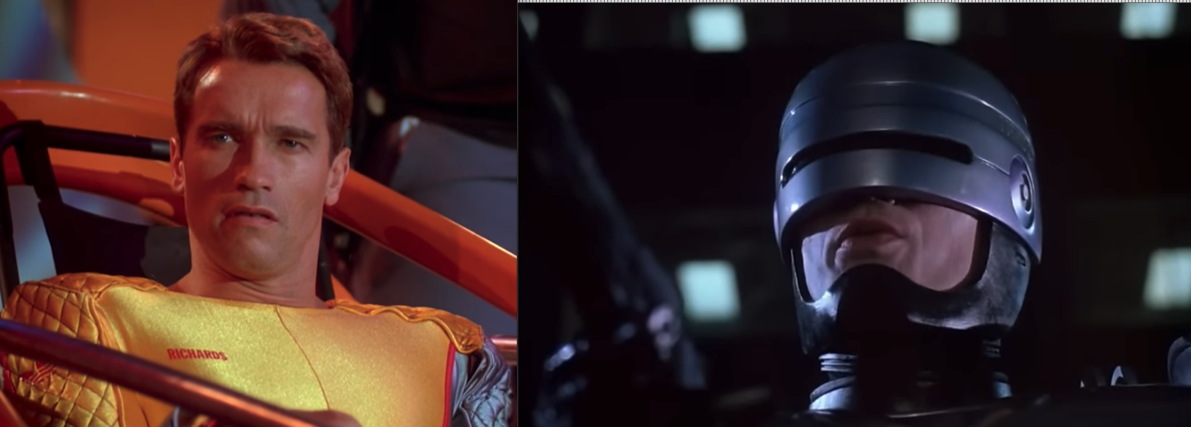
With a splashy studio action picture from Paramount Pictures starring Glen Powell, The Running Man, set for release in November, I thought it was a good time to reflect on the first film adaptation from 1987. Starring Arnold Schwarzenegger, and directed by “Starsky” Paul Michael Glaser, the dystopian sci-fi action movie was loosely based on Stephen King’s 1982 novel (under the pseudonym Richard Bachman).
Curiously enough, Paul Verhoeven’s similarly-themed RoboCop was also released earlier the same year. While both movies capture the anxieties of the late 1980s, focussing on corporate power, media manipulation, and social decay, RoboCop stands as the superior achievement in nearly every respect. It delivers richer storytelling, sharper satire, and more impressive craftsmanship on a smaller budget.
How do the two films compare?
In 1987, two dystopian science fiction action films captured very different visions of the future. The Running Man and RoboCop both explored authoritarian societies, corporate control, and media influence, yet the two films diverged sharply in tone, execution, and artistic ambition. Comparing them across plot, execution, cost, finesse, and results reveals why RoboCop endures as a cinematic landmark while The Running Man remains an entertaining but lesser cult favorite.
Plot
The Running Man presents a totalitarian future where criminals are forced to participate in a deadly televised game show, fighting for survival against professional killers known as “stalkers.” Its central themes revolve around media manipulation, fascism, and the use of entertainment to control the masses. The story is straightforward, functioning primarily as a vehicle for action and spectacle, with a touch of dark satire.
Similarly, RoboCop, set in a decaying Detroit controlled by a powerful corporation, follows a murdered police officer resurrected as a cyborg law enforcer. The film weaves together questions of identity, justice, and corporate corruption, exploring the tension between man and machine. Its narrative operates on multiple levels – part action film, part tragedy, and part political satire – giving it far greater thematic depth than The Running Man.
Execution
Directed by Paul Michael Glaser, The Running Man delivers a bright, campy, and television-like production style. Its tone is over-the-top and colorful, with Arnold Schwarzenegger’s charisma and one-liners driving the story more than its world-building or performances. The film feels like a comic book come to life; energetic but shallow.
Paul Verhoeven’s RoboCop, by contrast, is a masterclass in tonal balance. Blending graphic violence, dark humor, and biting satire, Verhoeven uses the film’s brutality to critique both corporate greed and society’s appetite for spectacle. Peter Weller’s restrained, haunting portrayal of RoboCop brings unexpected emotional depth to a character who could have been purely mechanical. Supported by a strong cast and meticulous direction, the film achieves a sophistication rarely seen in 1980s action cinema.
Cost
Despite its higher production budget of roughly $27 million, The Running Man often looks cheaper than its price tag suggests. Most of the film is set on studio soundstages with flat lighting and uninspired design, giving it the visual feel of a television production.
RoboCop cost about $13 million – notably, less than half the cost of its rival – but looks far more expensive. Through innovative use of prosthetics, miniatures, and practical effects designed by Rob Bottin, it created a gritty, believable vision of urban decay. Verhoeven’s team used every dollar efficiently, making RoboCop a model of economical filmmaking.
Finesse
The Running Man communicates its satire in broad strokes. Its critique of media culture is loud and obvious, relying on visual excess and catchphrases rather than nuance. While fun, it lacks the subtlety or artistry to elevate its message beyond surface-level entertainment.
RoboCop operates with remarkable finesse. Its visual metaphors, such as the rebirth of Murphy, the mechanization of justice, the fusion of flesh and metal, each carry philosophical weight. Basil Poledouris’s score adds a tragic, almost operatic layer to the story, reinforcing the conflict between man and machine. Verhoeven’s ironic use of fake commercials and newscasts deepens the film’s commentary on desensitization and consumerism, making it both entertaining and intellectually engaging.
Reception
At the box office, RoboCop earned about $53 million in the United States, surpassing The Running Man’s $38 million gross. Critically, RoboCop was widely praised for its originality and thematic ambition, earning a lasting reputation as a classic of science fiction cinema. It spawned sequels, reboots, comic books, video games, and extensive academic discussion.
The Running Man, while profitable and beloved by fans of 1980s action, achieved a smaller cultural footprint. It remains notable for its early prediction of reality television’s sensationalism but is remembered more as a Schwarzenegger vehicle than a groundbreaking film.
Conclusion
The Running Man succeeds as fast-paced entertainment, but RoboCop transcends its genre to become a powerful reflection on humanity, technology, and control.
The verdict is clear: RoboCop combines intelligence, emotion, and technical mastery, while The Running Man offers a flashy, enjoyable glimpse of dystopia without the same lasting resonance.
Cost (Production Value)
| Category | The Running Man | RoboCop |
|---|---|---|
| Budget | ~$27 million | ~$13 million |
| Look and Feel | Despite higher cost, it looks cheaper —
TV-set-style design, flat lighting. |
Lower budget but looks far richer —
strong art direction, innovative prosthetics, and effects by Rob Bottin. |
| Use of Effects | Minimal; mostly costumes and studio backdrops. | Extensive prosthetics, robotic effects,
and miniatures — all top-tier for the time. |
Verdict: RoboCop achieved far more on a smaller budget — clear win for efficiency and creativity.
Results (Cultural Impact, Critical and Financial Reception)
| The Running Man | RoboCop | |
| Box Office (US) | ~$38 million | ~$53 million |
| Critical Reception | ~65% | ~91% |
| Cultural Legacy | Cult favorite for Schwarzenegger fans;
known for its camp and “game show dystopia.” |
Classic of sci-fi cinema;
inspired sequels, reboots, comics, video games, and academic study. |
| Influence | Predicted reality TV to some extent. | Influenced cyberpunk, action cinema,
and the depiction of corporate dystopia. |
Verdict: RoboCop was both a commercial and artistic triumph. The Running Man remains entertaining but less influential.