
 Pauline Adamek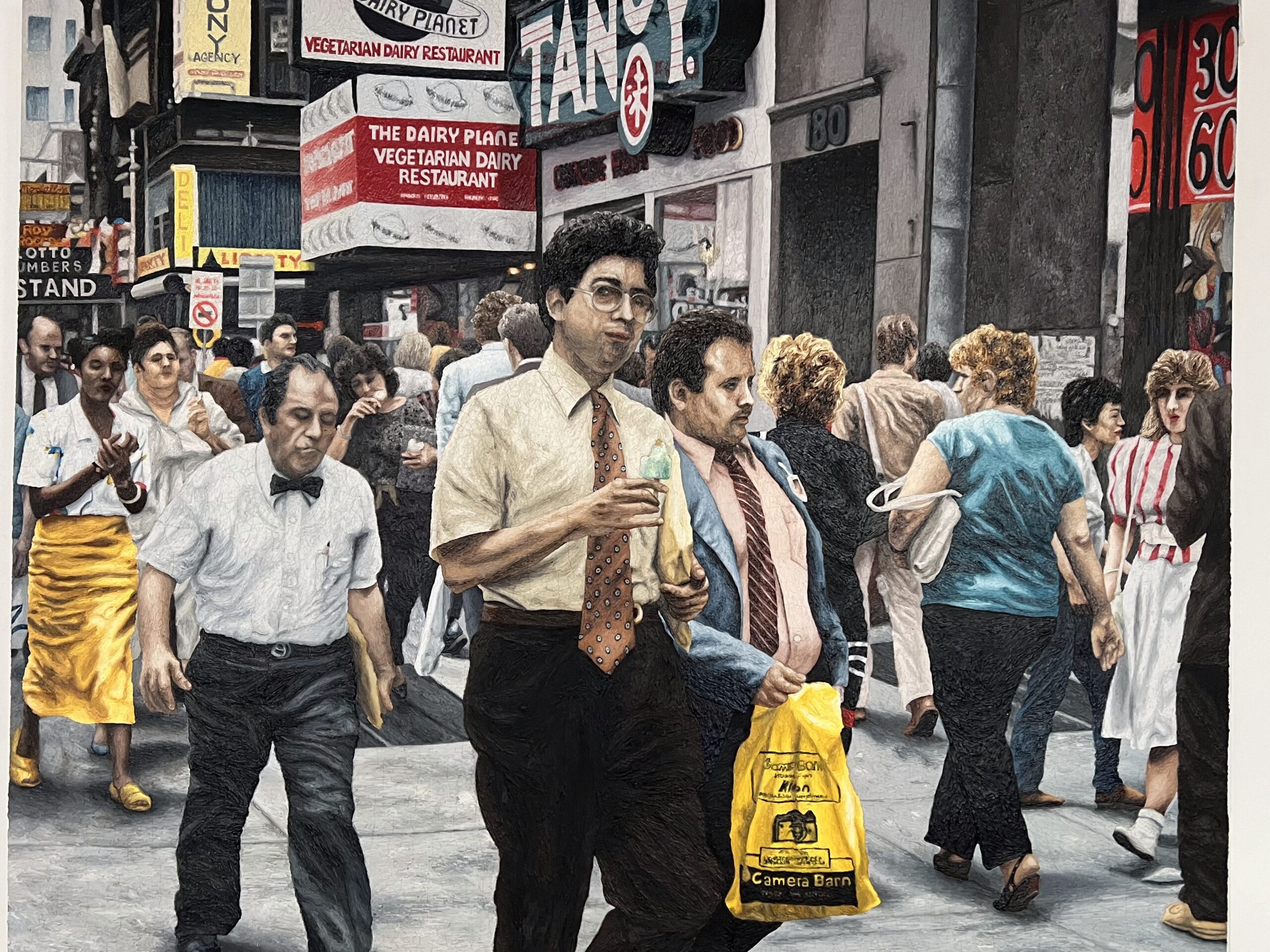
~~~
One of the most thrilling aspects of my career as a reporter and critic is getting to interact with the artistic community and discover new art. I was incredibly excited to see the new works by Los Angeles–based artist James Scanlon, whose paintings have appeared in feature films and on numerous TV shows. Most recently seen in all five seasons of Better Things, the artist even had fourteen of his paintings featured on the popular TV drama The Starter Wife.
The Starter Wife was created by Josann McGibbon and Sara Parriott. Originally produced as a miniseries in 2007, it was later picked up as a regular television series for a second season in 2008. It was based on the novel of the same name by Gigi Levangie Grazer and starred Debra Messing.
Better Things, created by and starring Pamela Adlon, was a sharply observed, deeply personal series that follows Sam Fox, a working actor and single mother raising three daughters in Los Angeles. Blending humor with raw emotional honesty, the show explored motherhood, aging, career uncertainty, friendship, and modern womanhood with remarkable authenticity. Loosely inspired by Adlon’s own life, Better Things is celebrated for its intimate storytelling, naturalistic performances, and its ability to find both comedy and poignancy in everyday moments. The series aired for five seasons on FX from 2016 until its final episode on April 25, 2022, and concluded with Season Five.
~~~
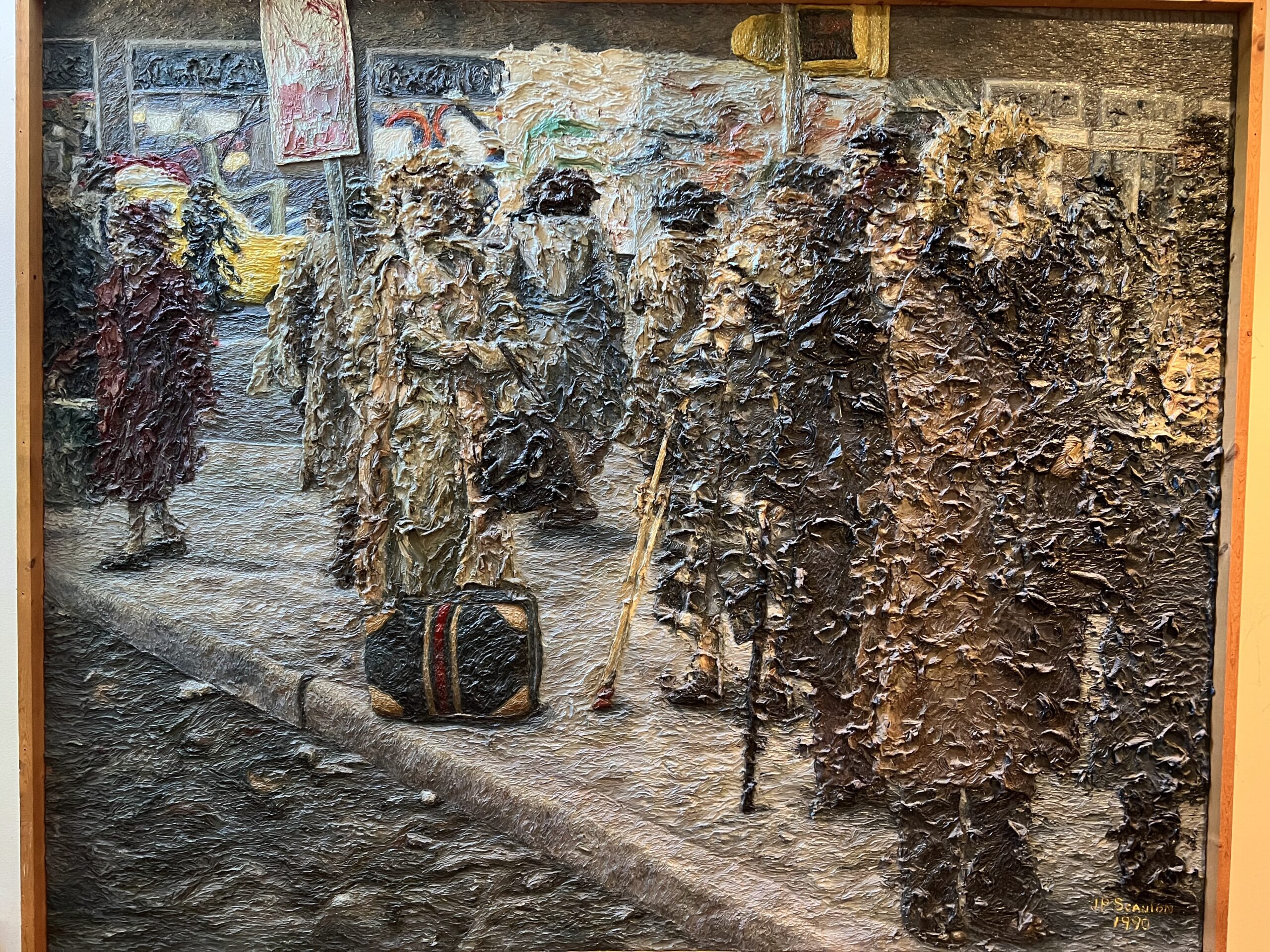
Scanlon’s approach is observational. Beginning with a well-composed, busy photograph, the artist then scrutinizes and transforms the image into a large, textural painting. Known for his thickly layered and complex artworks, Scanlon’s evolving painting style is truly unique. “Impasto” doesn’t properly describe his technique. Rather, it’s more like he’s sculpting with paint. Thick layers and colors of oil paint are delicately blended on the canvas, layer upon layer, to create a painting that becomes a three-dimensional structure. A graduate of the San Francisco Art Institute and the New York Studio School, Scanlon is largely self-taught, and his fine artworks are unlike anything I have ever seen. The artist creates a visually intriguing experience that invites you in to ponder and marvel. It becomes an experience where you immersive yourself, and become engulfed in the vivid scenes he has created.
Take, for example, the painting at the top, entitled Wall Street 1985. Here, he’s candidly capturing a busy street scene, one summer afternoon in Lower Manhattan. The figure at the center of the frame appears to notice the artist / photographer mid-stride. His gaze – frozen by the snap – locks eyes with ours. His flicker of a reaction is one of frowning suspicion, caught in the moment, perhaps mid-bite of his melting popsicle as indicated by his swelled cheeks. The painting offers a split-second of communion between us and this possible financier on NYC’s Wall Street.
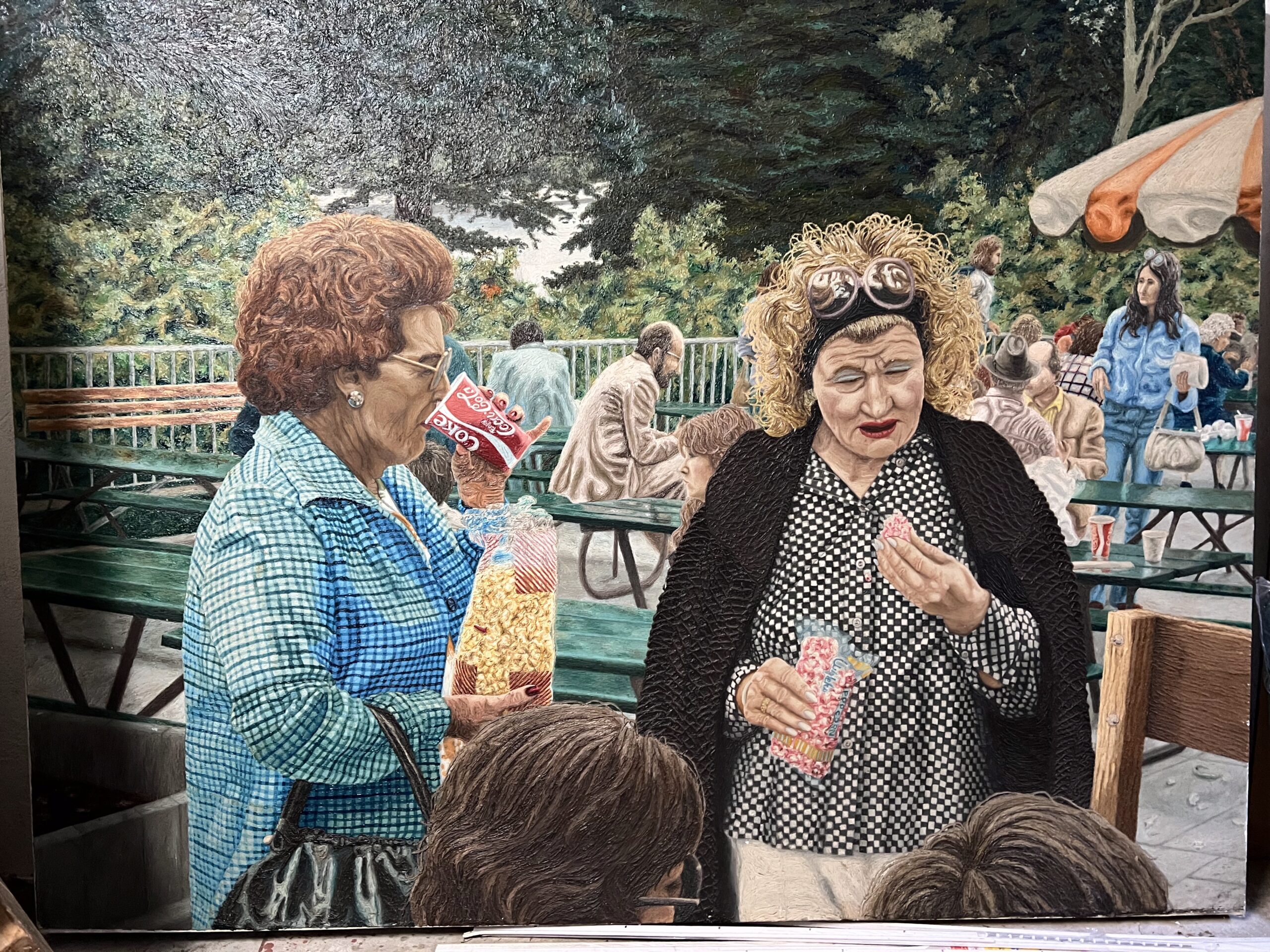
Impasto is a painting technique in which paint is applied thickly enough to create visible texture and raised surfaces on the canvas. Rather than being smoothly blended, the paint stands out in bold strokes, often applied with a brush or palette knife. This method adds dimension, movement, and physical presence to a work, allowing light to catch the surface and enhancing the emotional intensity of the image. Impasto is closely associated with artists like Vincent van Gogh, who used the technique to bring energy and depth to his paintings.
~~~
Never entirely comfortable with the business side of the art world, Scanlon worked in New York City during the eighties helping to create and design the decor for popular nightclubs such as Area MK and restaurants like The Odeon, while continuing to paint regularly. He later moved to Los Angeles to work as a production designer on numerous B-movies. Eventually, he transitioned to directing motion capture sequences, working on projects such as Titanic, The Matrix, and Spider-Man.
He is also the proud father of two accomplished daughters. Grace, his eldest, served as Director for West Africa at the Biden White House on the National Security Council. His youngest daughter Ruby currently works as a research assistant in Technology & National Security (essentially a “think-tank” located across the street from – and reporting to – the White House), having spent a year in China as a Schwarzman Scholar specializing in AI and its role between China and the rest of the world.
Now finally free to paint daily, the joy is readily apparent when speaking with the artist. The Impressionist movement is a favorite; Van Gogh and Gauguin both have been influential figures throughout his career and vocation.
While Scanlon has sold paintings at gallery shows, most of his sales come from buyers coming to his studio. The whole gallery system makes it hard on artists. The gallery itself takes at least half of the purchase price, which doubles what the artist feels a piece is worth. Says Scanlon, “It’s a big markup when you think how much people can afford to pay for something to hang on their walls.”
Studio visits are by appointment only. Contact the artist’s representative here or txt/call (310) 291-2005.
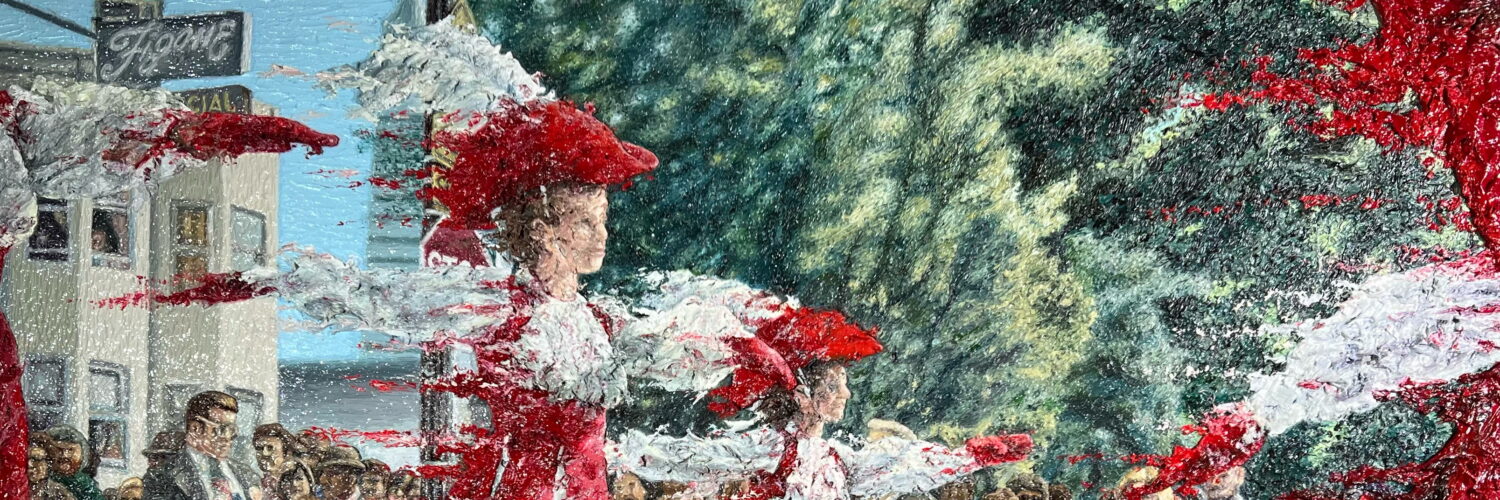
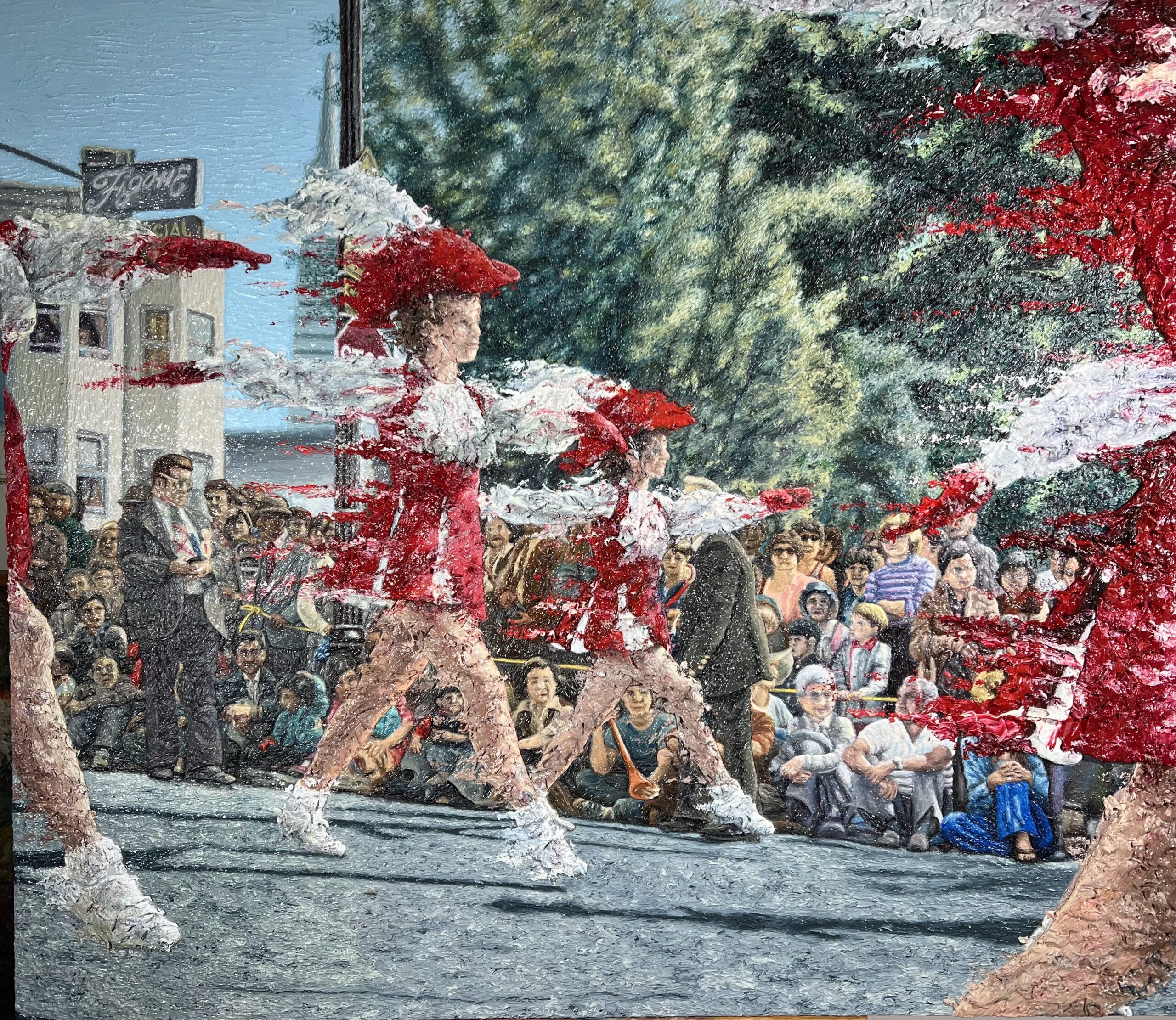
This painting below, Parade 2025, is a work that has been in the making for many years and was only recently completed. Featuring majorettes stepping perfectly in sync, our artist has frozen the moment. While energetically performing for an enthralled crowd, the regimented marchers are captured mid-step, but the artist creates the sensation they are all floating in mid-air – still perfectly in sync. The repeated addition of careful layers of impasto pushes the scene further into the abstract realm. Are they buoyed by wind or flames? It’s mesmerizing.
~~~
~~~
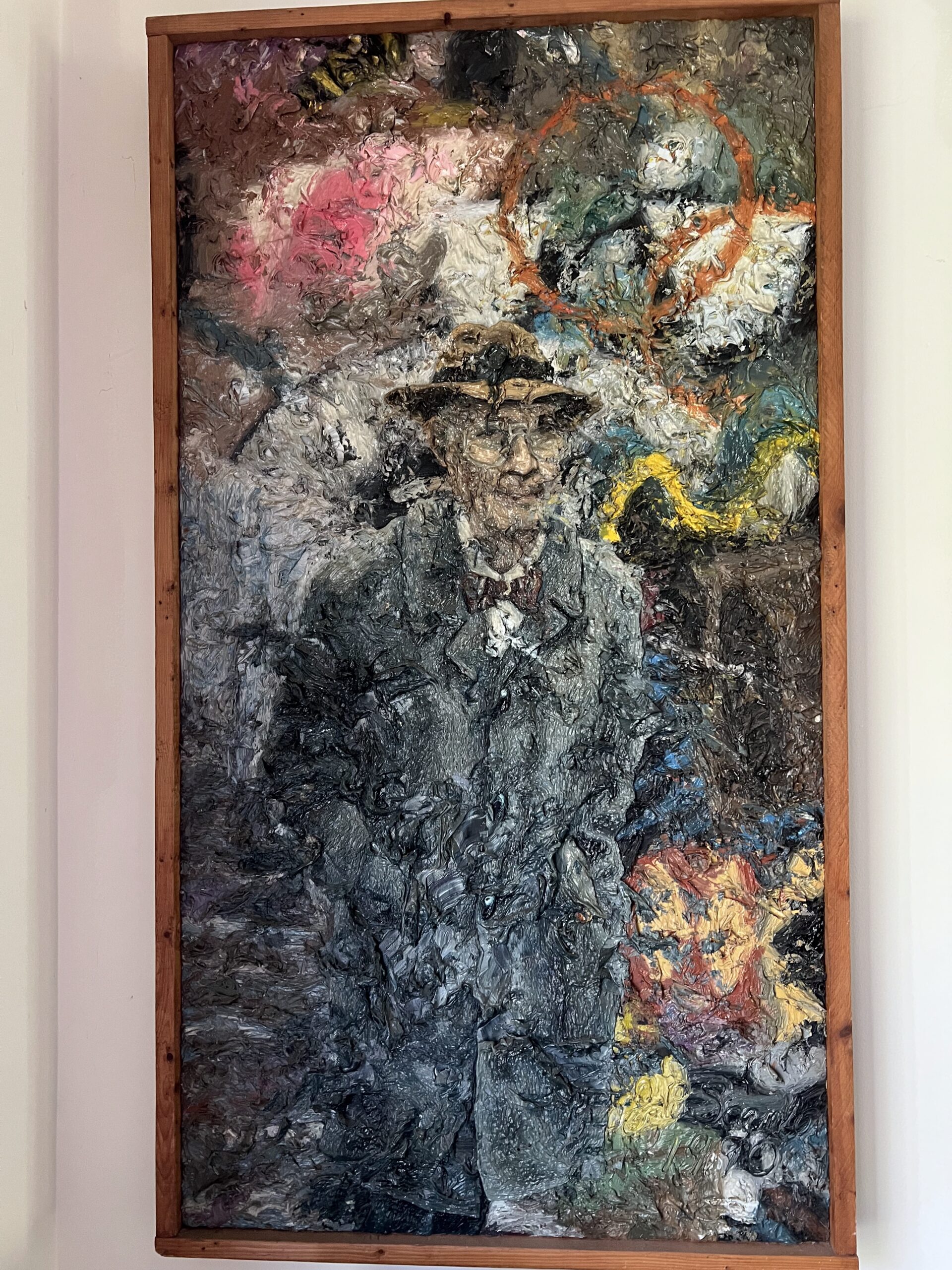
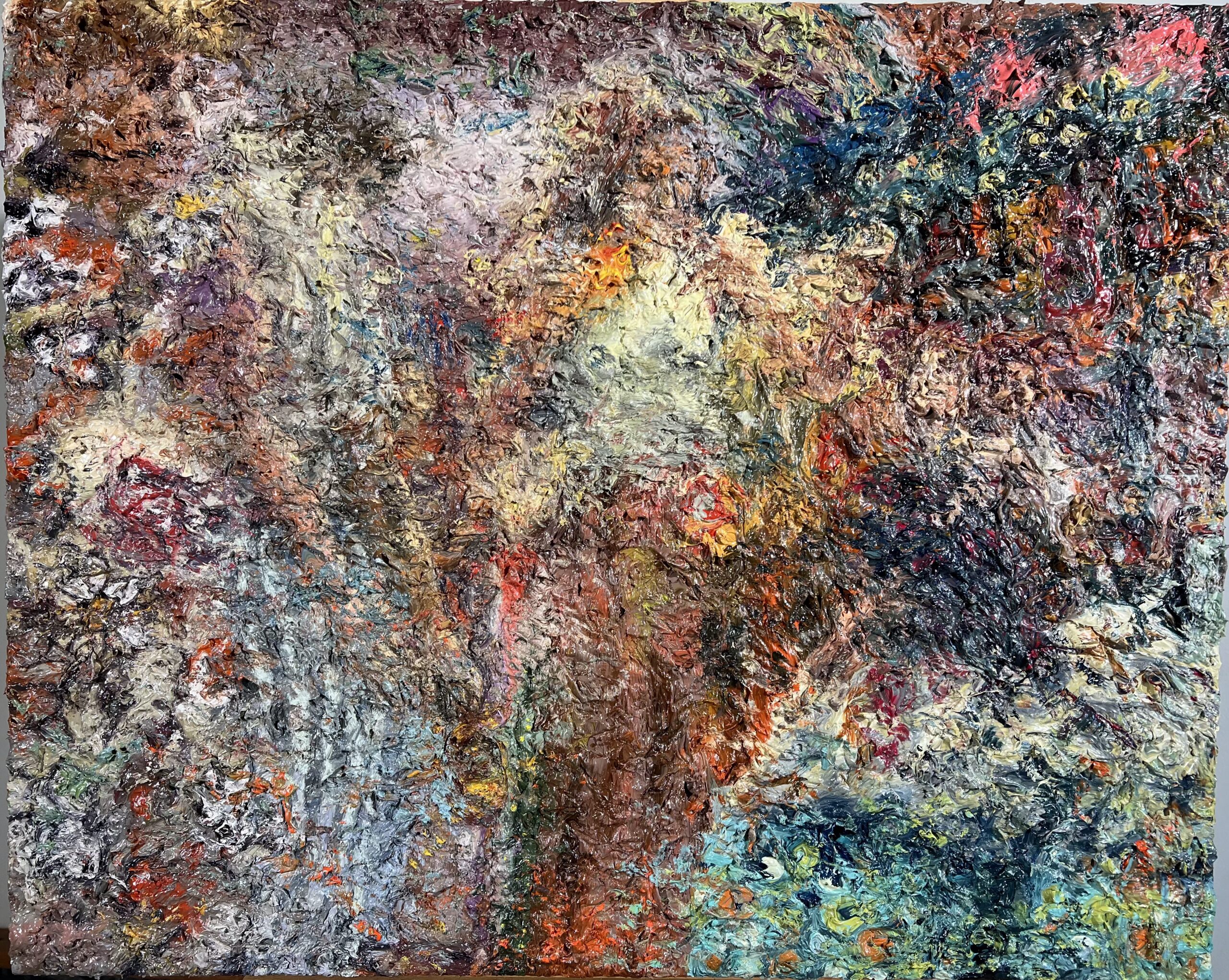
This work above, Nightclub 2026, is Scanlon’s most recent completed work, and it indicates a deeper exploration of the abstract. While you may discern a face within the feverish mêlée of the dancing attendees, the impressionistic whirl of colors and textures suggest the intense atmosphere of a popular dance club.
~~~
Talking to James Scanlon about his motivation, he says:
“Wanting to be unique in the art world is a challenge, but that is the goal. I want my work to be able to stand on its own.
“I am just another observer of the world. I try to make paintings that reflect what I feel, understand, and appreciate.
“I hope people think it’s palpably different from traditional styles of painting. Utilizing my own technique—the word ‘impasto’ doesn’t begin to fit as a description—after the paint has partially dried, I work the surface with a palette knife to further enhance the motion.
“If I have any goals in my life of painting, it would be to keep pushing myself and the boundaries of this technique—to create a style unlike any other. It is very hard to control a ridiculous amount of paint; therein lies one of the challenges. As the works become more three-dimensional, they become more like sculpting with paint.
“My paintings are about a love of paint and color. Painting with a lot of paint creates a surface that takes on a life of its own. The paint is not perfectly or smoothly applied; it lends itself to roughing the image in rather than rendering it flat and photo-like. It’s a goopy, paintbrush-sculpted relief that creates images I almost never intended to create. It’s as if they take on a life of their own, because the brush is small—but not small enough to render the image perfectly. So lots of mistakes happen, and after a while I have to settle. I can only blend so much before I lose the image.
“I want my paintings to have a funky, joyous feel. I want them to make people smile—to inspire them to walk around and visually explore the whole canvas. I depict images from the past and present, or moments in time that I thought were significant or cool. I reference a time I love—before iPhones were around, before computers were what people were tethered to. I grew up in a time of seemingly much greater freedom.
“The changes the world has gone through are, in my opinion, much more restrictive. Now everyone knows where everyone is, what they are doing, what they ate last night, and what they were wearing—none of it very important or interesting. I am trying to capture those earlier times for everyone to observe.
“In one of my latest paintings, people are watching majorettes marching perfectly in time down the street. It reflects a simpler way of living. Everyone is happy just watching and being in the moment. No one lives in the moment anymore—they’re all busy recording their lives, usually never to be seen again, and thus missing out on truly experiencing the moment. Which is a shame.”


 Terry Morgan