

 Pauline Adamek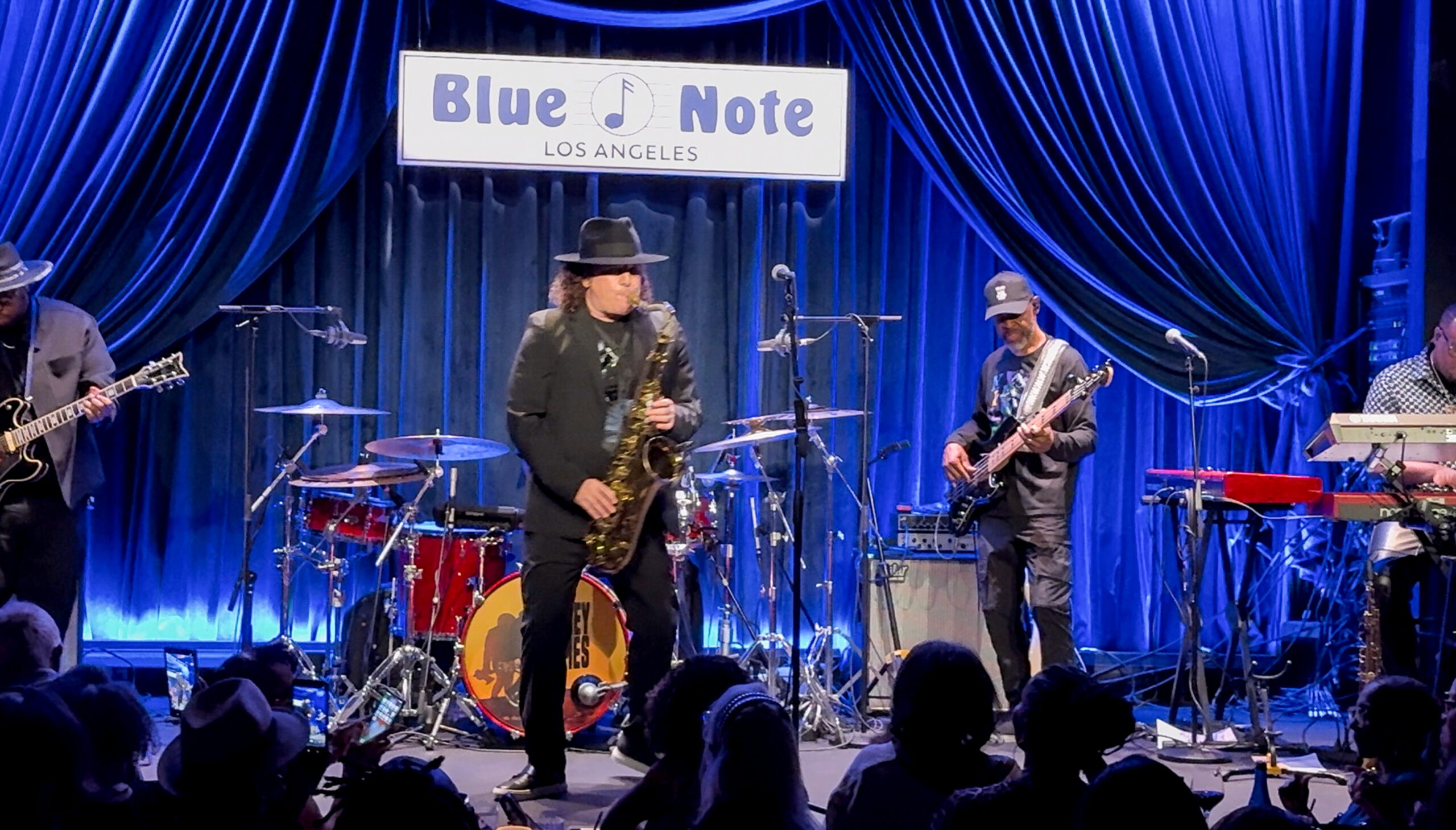
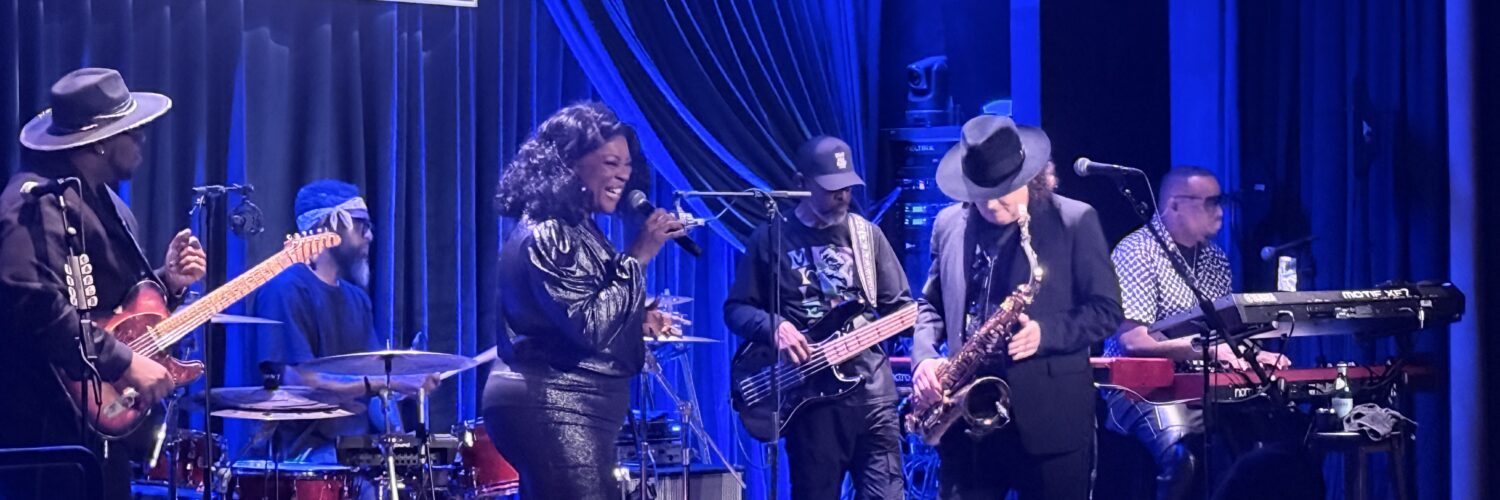
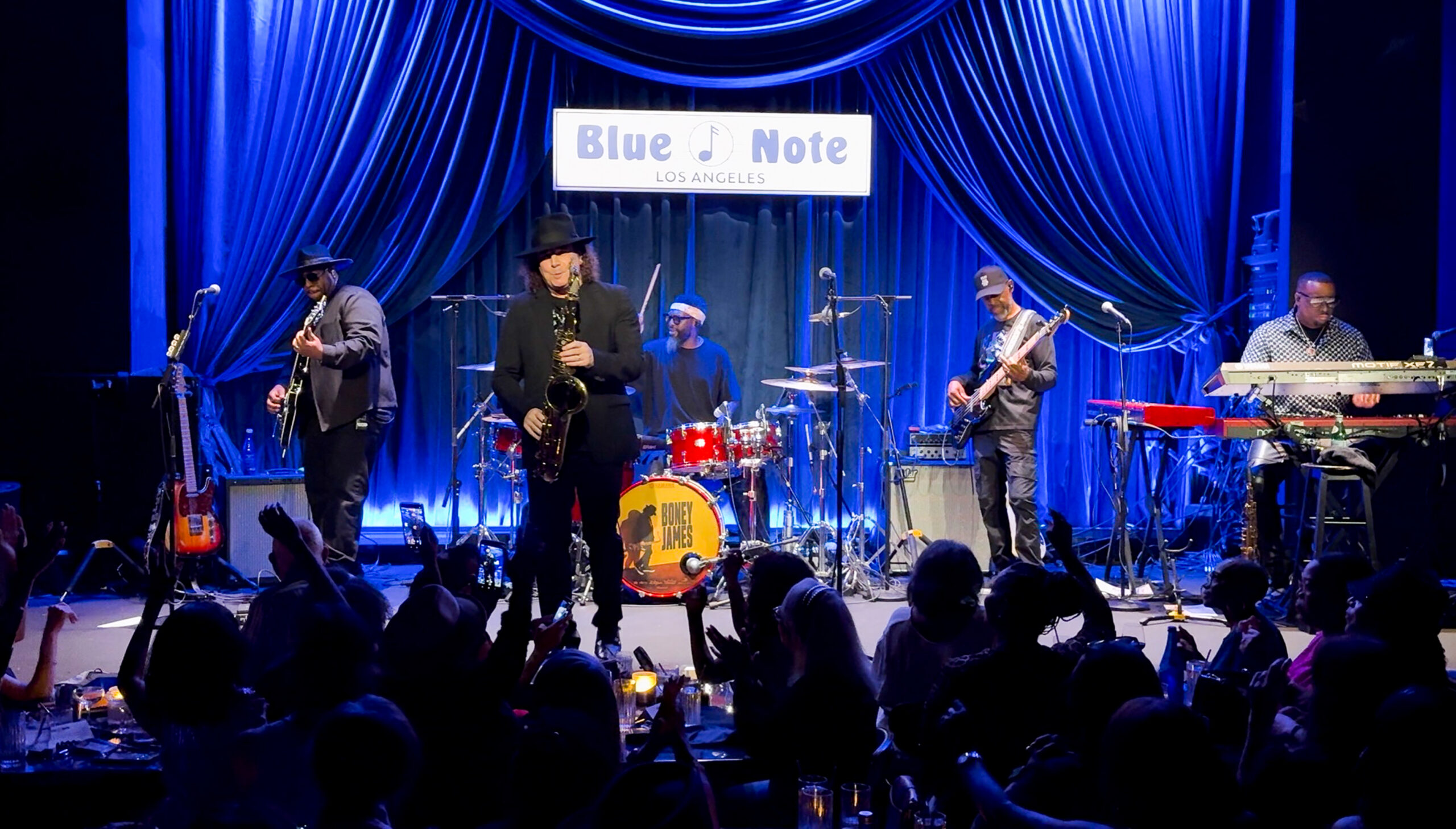
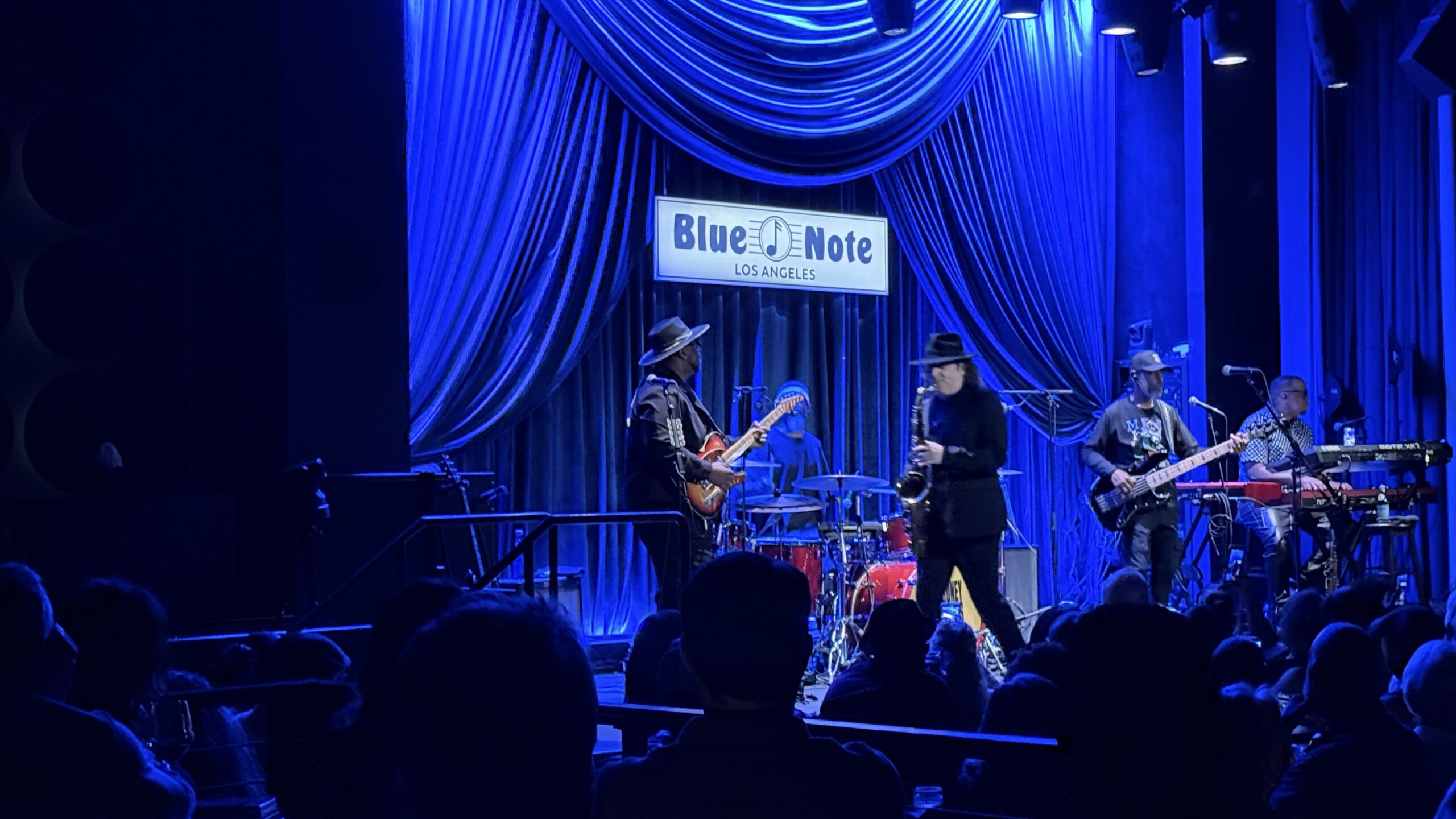
It was a packed house at Blue Note Jazz club in LA last week when artist Boney James strode onto the intimate nightclub’s stage, joining his band with a huge smile on his face. Greeted by an enthusiastic crowd, the ensemble immediately launched into a series of up-tempo tunes that had us all grooving.
Boney James was here to celebrate the release of his 20th studio album, A Simple Man, via Concord Records. He marked the milestone occasion with two sold out shows. (Above photo credit @Darnell Gamble.)
James is more than three decades into an acclaimed career as a recording artist, with four GRAMMY nominations, multiple Gold records, and—by 2024—his historic 20th No. 1 single on Billboard’s Smooth Jazz chart. The musician is known for his deep groove, his melodic instinct and a saxophone voice unmistakably his own, yet Boney James is still exploring new ground.
On A Simple Man, the multi-platinum saxophonist, composer and producer turns inward without narrowing his musical world. The result is one of his most personal records: R&B feeling remains at its center, jazz tradition is honored, and James sounds every bit like a musician still striving for new possibilities on his instrument.
Renowned for his ability to make his saxophone function like an R&B vocalist, James continued his set by turning to his new album, A Simple Man. He introduced the tune “Storybook,” which marks his collaboration with guitarist Larry Carlton. Onstage, guitarist Big Mike Hart stepped into Carlton’s role, even dusting off a 335-style semi-hollowbody guitar for the occasion. James joked that the band had learned most of the new material only the day before, adding an element of spontaneity to the performance.
“It’s been a long time since I played a club this size here in town, we’re really glad all you guys came in and sold the club out.” Indeed, James had recently co-headlined the Hollywood Bowl’s Smooth Summer Jazz concert alongside The Commodores, Sheila E. and the E-Train opening. The Los Angeles Philharmonic presented the evening as a meeting of contemporary jazz, R&B and funk.

The relaxed banter continued as James noted that, despite the jazz-club setting, his musical roots have always been firmly planted in R&B. When he listens to jazz, he described, he naturally imagines an R&B groove underneath it. That sensibility shaped his new interpretation of Duke Ellington’s “In a Sentimental Mood.” James explained, “In my head, I heard it as if Duke Ellington and D’Angelo were playing it together. So this is my new version on the new CD of a beautiful song.”
James’ description of the song as a meeting between Duke Ellington and D’Angelo captures the musical idea behind his arrangement. Ellington represents the elegance, harmonic sophistication and timeless melodic language of classic jazz, while D’Angelo brings the deep, sensual pocket of modern soul and R&B. Through James’ interpretation, Ellington’s composition remains intact at its core, but the rhythm is recast with the kind of relaxed, behind-the-beat R&B groove associated with D’Angelo. It is a concise way of explaining James’ own musical philosophy – taking something rooted in the jazz tradition and filtering it through the sounds and rhythms that have shaped him over the years.
James then reflected on another major influence, saxophonist Grover Washington Jr., saying he would not be onstage with a saxophone today if he hadn’t heard Washington’s music back in the 1970s. The tribute brought one of his favorite Grover Washington songs into the set, connecting James’ contemporary sound directly to one of the musicians who helped define the jazz-R&B crossover.
From there, the mood shifted toward Latin rhythms. James introduced “Batucada,” the title track from his 2013 album The Beat, explaining that the Portuguese word refers to a rhythmic percussion style and that the song was originally recorded by Sérgio Mendes in the late 1960s. James’ version reflects his longtime interest in combining Latin music with R&B, giving the performance a distinctly rhythmic, dance-oriented character. Big Mike Hart was again featured prominently on guitar.
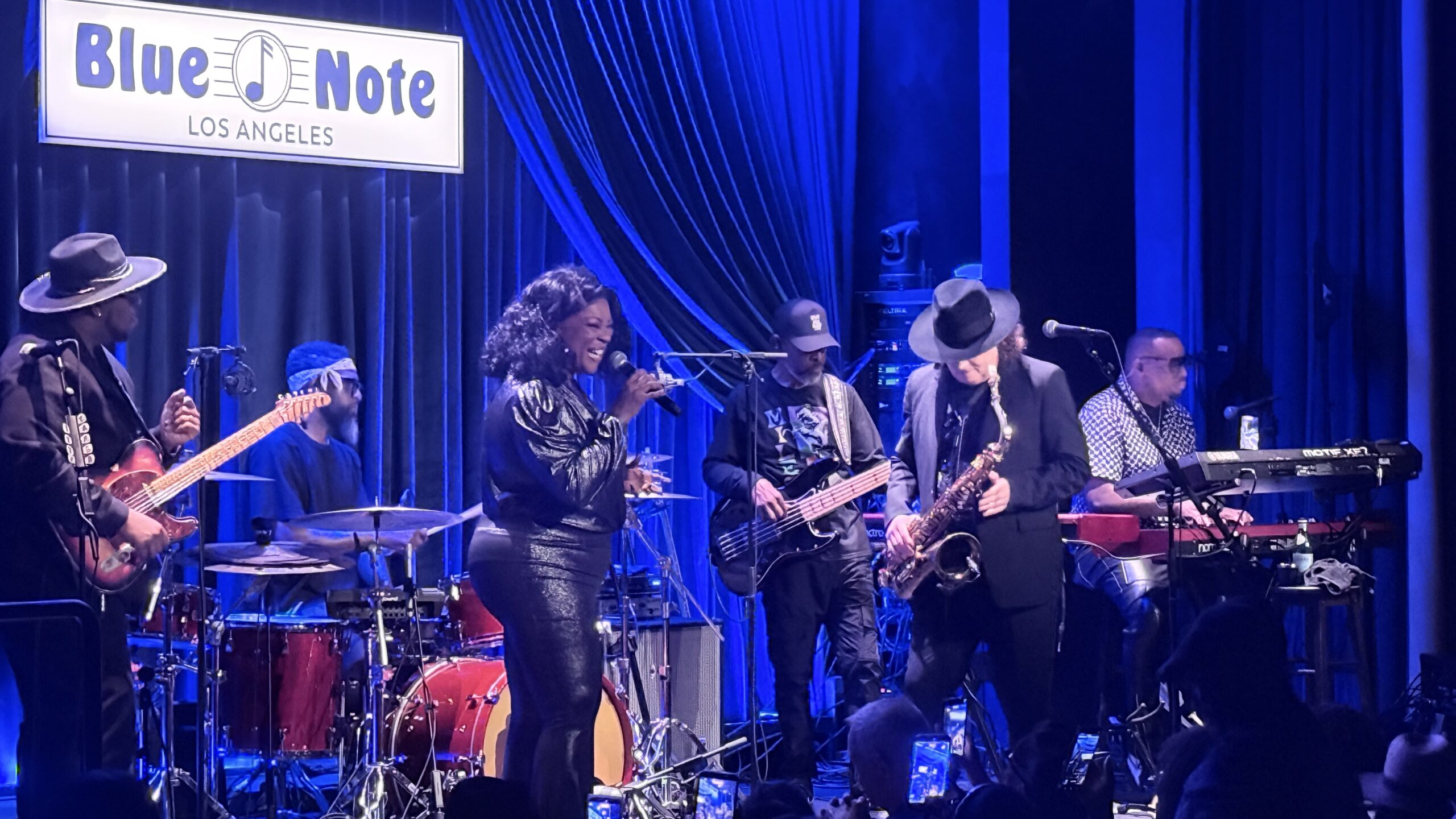
Back in the spotlight, James returned to A Simple Man and introduced “I Belong to You,” his R&B single featuring singer Ledisi. He told the audience that releasing an R&B single as a saxophonist was something of a risk, but said he was grateful that the song was climbing the R&B charts. With Ledisi unavailable that evening because of her upcoming Broadway debut, singer Monet stepped in to perform the song, earning a warm Los Angeles welcome from the crowd.
James then shifted gears with “Butter,” a song he noted had been released roughly 15 years earlier without attracting much attention at the time. Years later, he said, it had become his “most streamed song” – an unexpected second life for a track that had initially gone largely unnoticed.
As the band launched into the groove, James turned the audience into part of the performance, asking everyone to snap along “with a little attitude.” The room responded, transforming the club from a conventional concert setting into something closer to a communal R&B groove, with James and the band riding the rhythm while the audience became part of the arrangement.
What a night!
About Boney James: Three Decades of Finding the Soul in the Saxophone
There are musicians who play the saxophone, and then there are musicians who make the saxophone feel like a human voice. Boney James belongs firmly in the second category.
Over a career spanning more than three decades, James has built one of the most recognizable sounds in contemporary jazz: warm, melodic, polished and deeply rooted in the rhythms of R&B and soul. His music is often filed under “smooth jazz,” a label that describes his commercial territory but doesn’t fully capture the breadth of his musical vocabulary. James is as much a product of Stevie Wonder, Marvin Gaye, Earth, Wind & Fire and contemporary R&B as he is of the jazz tradition. That combination has made him one of the most enduring instrumental artists of his generation.
From James Oppenheim to Boney James
Born James Oppenheim on September 1, 1961, in Lowell, Massachusetts, James grew up in New Rochelle, New York, in a musical environment that exposed him to an unusually wide range of sounds. He began on clarinet as a child before switching to saxophone in fifth grade.
His early musical influences were similarly diverse. Jazz and classical music shared space with film scores, Broadway musicals and the soul and R&B records of artists such as Stevie Wonder, Marvin Gaye, Curtis Mayfield and Earth, Wind & Fire. Those influences would eventually become central to the musical identity he developed as a recording artist.
As a teenager, James moved to Los Angeles, where he began establishing himself professionally. By the age of 19, he was working as a musician, and before launching his solo career he gained valuable experience performing and touring with artists including Morris Day, the Isley Brothers, Teena Marie, Randy Crawford, Ray Parker Jr., Sheena Easton and Bobby Caldwell.
James didn’t emerge as a solo artist in isolation. He learned the language of professional R&B and pop performance from inside some of the music industry’s most accomplished bands and touring productions.
Even his stage name has an R&B-road-life origin. During a 1987 European tour with Randy Crawford, a bandmate reportedly began calling the slender saxophonist “Boney James.” The nickname stuck, eventually becoming the name under which he would build his career.
Building a sound of his own
James launched his solo career with Trust in 1992, initially releasing the album independently. From the beginning, the record established many of the qualities that would define his music: strong melodies, polished production, soulful grooves and a saxophone sound that prioritizes expression over technical display.
James is certainly a technically accomplished saxophonist, but virtuosity has rarely been the point of his music. His playing is deliberately melodic. Rather than treating the saxophone as an instrument for extended displays of improvisational technique, he frequently uses it as a vocalist might use a voice: phrasing a melody, shaping individual notes and allowing tone to carry emotion.
The result is music that can feel immediately accessible without being musically simplistic.
Albums such as Backbone (1994), Seduction (1995), Sweet Thing (1997), Body Language (1999) and Ride (2001) established James as a major presence in contemporary jazz. With each release, he refined a formula that was becoming unmistakably his own: jazz musicianship filtered through soul, funk, R&B and contemporary studio production.
More than “smooth jazz”
Calling Boney James a smooth-jazz artist is accurate, but incomplete. The label tells you where much of his music sits commercially and stylistically, but it doesn’t explain why his work has connected with audiences for so long. His musical foundation is considerably broader.
James’ music occupies a space where jazz harmony, R&B rhythm, funk, soul melody and modern production meet. His saxophone may carry the lead, but the records are often constructed like R&B records, with carefully shaped grooves, keyboards, bass, drums, programmed elements and guest vocalists all contributing to the final sound.
This is one reason his music can appeal to listeners who don’t ordinarily consider themselves jazz fans. The melodies are accessible, the grooves are immediate and the production is designed to create a strong atmosphere.
There is also a strong emotional consistency to his work. Whether he’s playing something romantic, reflective, funky or relaxed, James tends to favor warmth and restraint. He rarely seems interested in overwhelming the listener. His music invites the listener in.
The collaborative side of Boney James
Another defining characteristic of James’ career is his willingness to work across musical boundaries. Over the years, he has collaborated with artists including George Benson, Al Jarreau, George Duke, Lalah Hathaway, Bilal, Kenny Lattimore, Raheem DeVaughn, October London, Ledisi and Larry Carlton.
Those collaborations aren’t merely celebrity appearances. They illuminate the different sides of James’ musical personality. His work with vocalists demonstrates how naturally his saxophone fits into an R&B setting. His collaborations with instrumentalists, meanwhile, reveal a musician comfortable sharing space with other highly distinctive voices.
Lalah Hathaway has been an especially notable collaborator. Their work together illustrates one of James’ greatest strengths: his ability to make the saxophone function almost like another vocalist, answering, supporting and extending the emotional message of the song.
His collaborations have also allowed James to remain connected to contemporary music rather than becoming locked into the sound of a particular decade.
The producer behind the saxophone
It would be easy to focus exclusively on James as a saxophonist, but doing so misses a major part of his achievement. James is also a composer, arranger and producer, and his growing involvement in the production of his albums has played an important role in defining his sound.
His records aren’t simply showcases for saxophone solos. They are carefully constructed sonic environments. The bass, drums, keyboards, programmed elements, guitar, vocals and saxophone are arranged to create a particular mood, with James’ horn serving as the central melodic voice. That production sensibility helps explain the longevity of his recordings. His music has evolved with recording technology and contemporary R&B without abandoning the characteristics that made his early work distinctive.
A career measured in decades
James’ longevity is one of the most remarkable aspects of his career. His discography has grown to 20 studio albums, beginning with Trust in 1992 and continuing through A Simple Man in 2026. Along the way, he has accumulated four Grammy nominations, including recognition for Ride, Pure, The Beat and his collaboration with Quinn on “Don’t Let Me Be Lonely Tonight.”
He has also received NAACP Image Award nominations, won a Soul Train Award and earned multiple RIAA Gold certifications.
Perhaps the clearest measure of his staying power, however, is his relationship with the Billboard Smooth Jazz chart. In 2024, James became the first artist to reach 20 No. 1 singles on that chart. The statistic is impressive not simply because of the number itself, but because it represents sustained audience interest over a period in which the music business, listening habits and recording technology have changed dramatically.
His official biography also reports more than two billion U.S. on-demand streams and the equivalent of approximately four million U.S. album sales.
The evolution continues
James’ 2026 album, A Simple Man, offers a useful snapshot of where his music stands today.
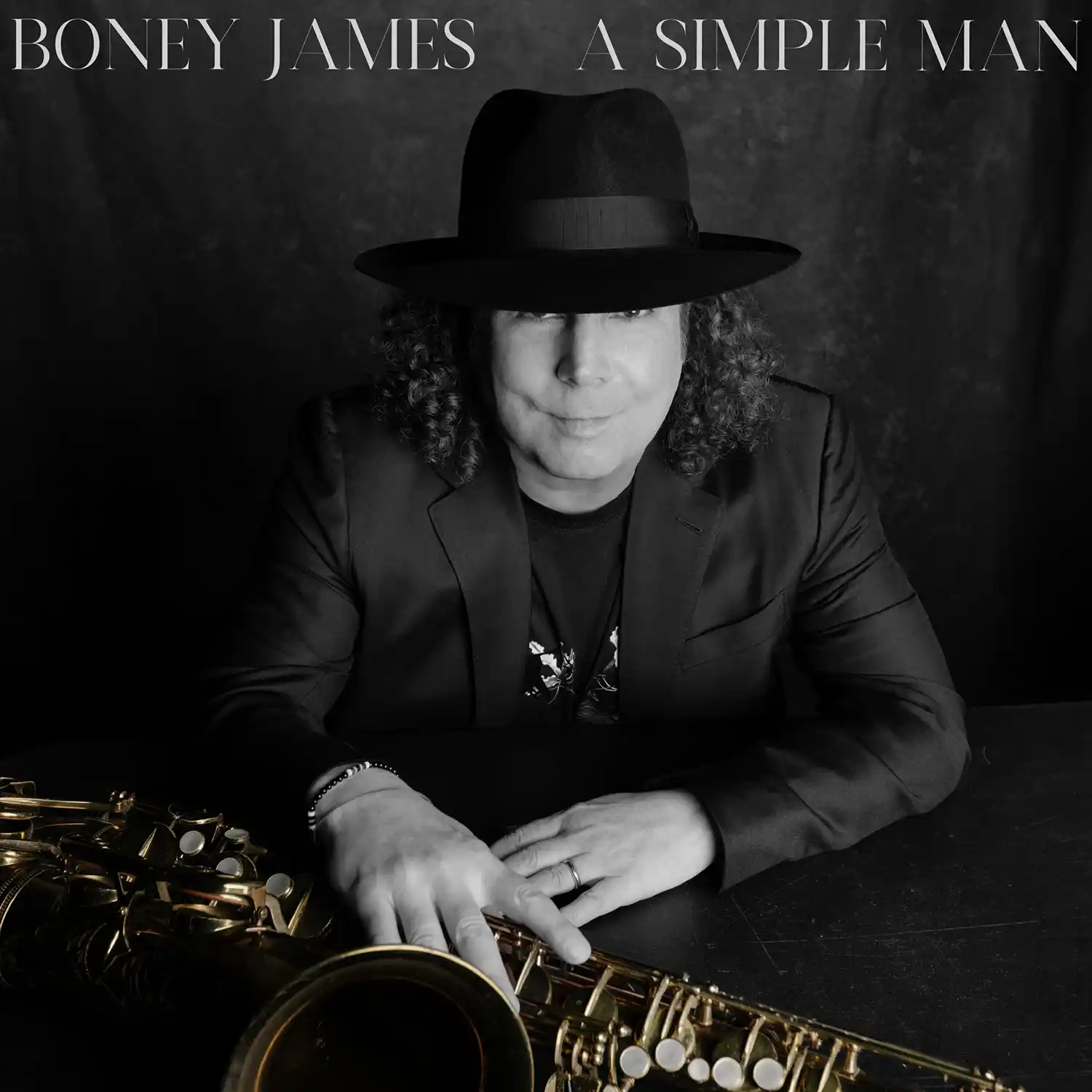
Released through Concord Records, the album is his 20th studio recording and contains 10 tracks, including collaborations with Ledisi on “I Belong To You” and guitarist Larry Carlton on “Storybook.”
The album’s title suggests a shift in perspective. James has described the idea behind A Simple Man in terms of becoming more interested in uncomplicated, positive things and filtering out unnecessary noise.
Musically, however, the album doesn’t represent a retreat into nostalgia. Instead, it continues the process that has characterized much of his career: bringing his established saxophone voice into contemporary production while maintaining his connection to soul, jazz and R&B.
The collaboration with Carlton is particularly intriguing. Carlton’s guitar and James’ saxophone occupy similar melodic territory, but they have distinctly different tonal personalities. Pairing them creates a conversation between two veteran instrumental voices rather than simply placing a guest musician on top of a finished track.
What makes Boney James distinctive?
The easiest answer is his saxophone tone. It is warm, rounded and immediately recognizable. But tone alone doesn’t explain his success. His greater achievement is knowing what to do with that sound.
James understands melody. He understands groove. He understands the importance of space.
And perhaps most importantly, he understands that an instrumentalist doesn’t always need to demonstrate everything he can play.
His strongest performances often feel conversational rather than competitive. The saxophone sings rather than shouts. A phrase may be technically simple, but the way James bends a note, holds a tone or places a phrase against the rhythm section can give it considerable emotional weight. That restraint is one reason his music has remained accessible across generations.
The Boney James legacy
Boney James occupies an interesting position in American music. He is undeniably a jazz musician, but his greatest influence has come from refusing to treat genre boundaries as fixed walls.
His career connects the jazz tradition to the sounds of soul and R&B, the studio sophistication of contemporary pop and the increasingly electronic production techniques of modern music.
He has also demonstrated that instrumental music can have a sustained commercial life without abandoning melody or emotional accessibility.
Three decades after his solo debut, James remains recognizable within seconds of a recording beginning. That may be the most meaningful measure of an artist’s identity. The sound is unmistakably his.
And after 20 studio albums, countless collaborations, Grammy nominations, chart records and billions of streams, Boney James has established himself not merely as a successful smooth-jazz saxophonist, but as a distinctive musical voice whose career has been built around a deceptively simple idea: make the saxophone sing.
Boney James — A Simple Man Tour Dates
| Date | City | Venue |
|---|---|---|
| Oct. 4, 2026 | Temecula, CA | Thornton Winery |
| Oct. 16, 2026 | Rehoboth Beach, DE | Rehoboth Beach Convention Center |
| Oct. 17, 2026 | Annapolis, MD | Rams Head On Stage |
| Oct. 18, 2026 | Red Bank, NJ | The Vogel |
| Oct. 23, 2026 | Newport Beach, CA | Hyatt Regency |
| Oct. 24, 2026 | Napa, CA | Blue Note Napa |
| Oct. 25, 2026 | Lancaster, CA | Lancaster Performing Arts Center |
| Oct. 29, 2026 | Alexandria, VA | The Birchmere |
| Oct. 30, 2026 | Lansdowne, PA | Lansdowne Theater |
| Oct. 31, 2026 | Boston, MA | City Winery |
| Nov. 1, 2026 | New York, NY | Sony Hall |
| Nov. 8, 2026 | St. Louis, MO | The Factory |
| Nov. 14, 2026 | Charlotte, NC | Knight Theater |
| Nov. 15, 2026 | Birmingham, AL | The Lyric Theatre |
| Nov. 20, 2026 | Detroit, MI | Sound Board at MotorCity Casino |
| Nov. 21–22, 2026 | Chicago, IL | City Winery |
| Nov. 24, 2026 | Minneapolis, MN | Dakota |
| Dec. 4, 2026 | New Orleans, LA | The Fillmore |
| Dec. 6, 2026 | Houston, TX | House of Blues |
| Dec. 11–13, 2026 | Seattle, WA | Jazz Alley |
| Dec. 29–31, 2026 | Oakland, CA | Yoshi’s |
| Jan. 16, 2027 | Fayetteville, GA | Trilith LIVE |
| Jan. 29, 2027 | Chandler, AZ | Chandler Center for the Arts |
More information can be found here.


 Terry Morgan