

 Pauline Adamek
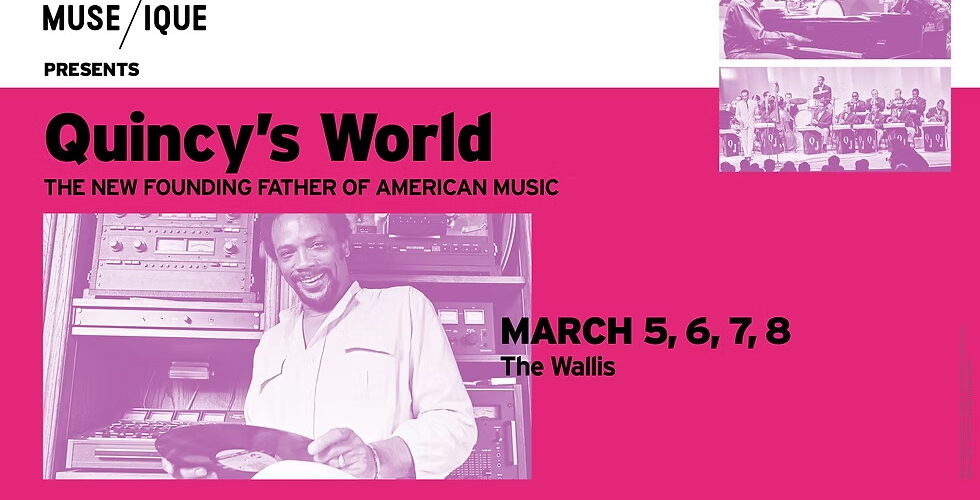
MUSE/IQUE honors the late Quincy Jones in performances entitled Quincy’s World The New Founding Father of American Music, conducted by Artistic and Music Director Rachael Worby,March 5-8, 2026 at the Wallis Center for the Performing Arts, in Beverly Hills. Vocalists Vanessa Bryan and Tony and GRAMMY® award winner Brandon Victor Dixon join MUSE/IQUE at these concerts.
Above photo: Guest Vocalist Brandon Victor Dixon joins Artistic and Music Director Rachael Worby as she conducts MUSE/IQUE. Photos by Haoyuan Ren, courtesy of MUSE/IQUE.
Quincy Jones changed the face of music: this bold, brave, multi-hyphenate music mogul boasts a storied musical legacy unlike anyone else – record producer, multi-instrumentalist, songwriter, composer, arranger, and living legend – his career spans more than 70 years in the entertainment industry.
“Quincy Jones is synonymous with American music. In light of his recent death, we celebrate Quincy’s power as a social activist and changemaker, influencing some of the biggest names in music and opening the door for future generations.” Artistic and Music Director Rachael Worby.
At this concert, MUSE/IQUE traces his journey from playing trumpet alongside jazz icon Dizzy Gillespie, to his accolades as a groundbreaking film composer, to his breathtaking collaborations with Frank Sinatra and Michael Jackson, and beyond.
Jones was nominated for a GRAMMY® Award 80 times and won 28 GRAMMYS®, including the GRAMMY® Legend Award in 1991. In 2008, he received an NEA Jazz Masters award. He was one of 22 EGOT (Emmy, Grammy, Oscar, Tony) holders in history including having received seven Academy Award nominations, and the Academy of Motion Picture Arts and Sciences’ Jean Hersholt Humanitarian Award. He was the recipient of the Republic of France’s Commandeur de la Legion d’ Honneur. Jones received the 2010 National Medal of Arts, the highest award given to artists and arts patrons by the United States government, from President Barack Obama at a White House East Room ceremony in March 2011.
The artist produced the best-selling album of all time, Michael Jackson’s “Thriller” with sales of 110 million copies worldwide and six Top Ten singles, and was the producer and conductor of the best-selling single of all-time at 20 million copies “We Are the World,” which raised tens of millions for the victims of Ethiopia’s famine in 1985.
The program includes highlights of Quincy Jones’ legendary musical career and shows the range of his musical accomplishments:
- “Fly Me to the Moon” and “I Can’t Stop Loving You” from the Frank Sinatra-Count Basie album “It Might As Well Be Swing” arranged and conducted by Jones
- “Human Nature” by Michael Jackson from “Thriller”
- Two hits from his executive tenure at Mercury Records — Lesley Gore’s “It’s My Party” and Dinah Washington’s “Mad About the Boy”
- Rodgers and Hart’s “Bewitched” a highlight of the Lena Horne Broadway show, “The Lady and her Music” – cast album produced by Jones
- A selection of his film and television arrangements — “Soul Bossa Nova” from “Austin Powers”, and “In the Heat of the Night” with lyrics by Alan and Marilyn Bergman and this title song introduced by Ray Charles
- “The Color Purple” – Jones both composed and created the score and was a producer of the film directed by Steven Spielberg
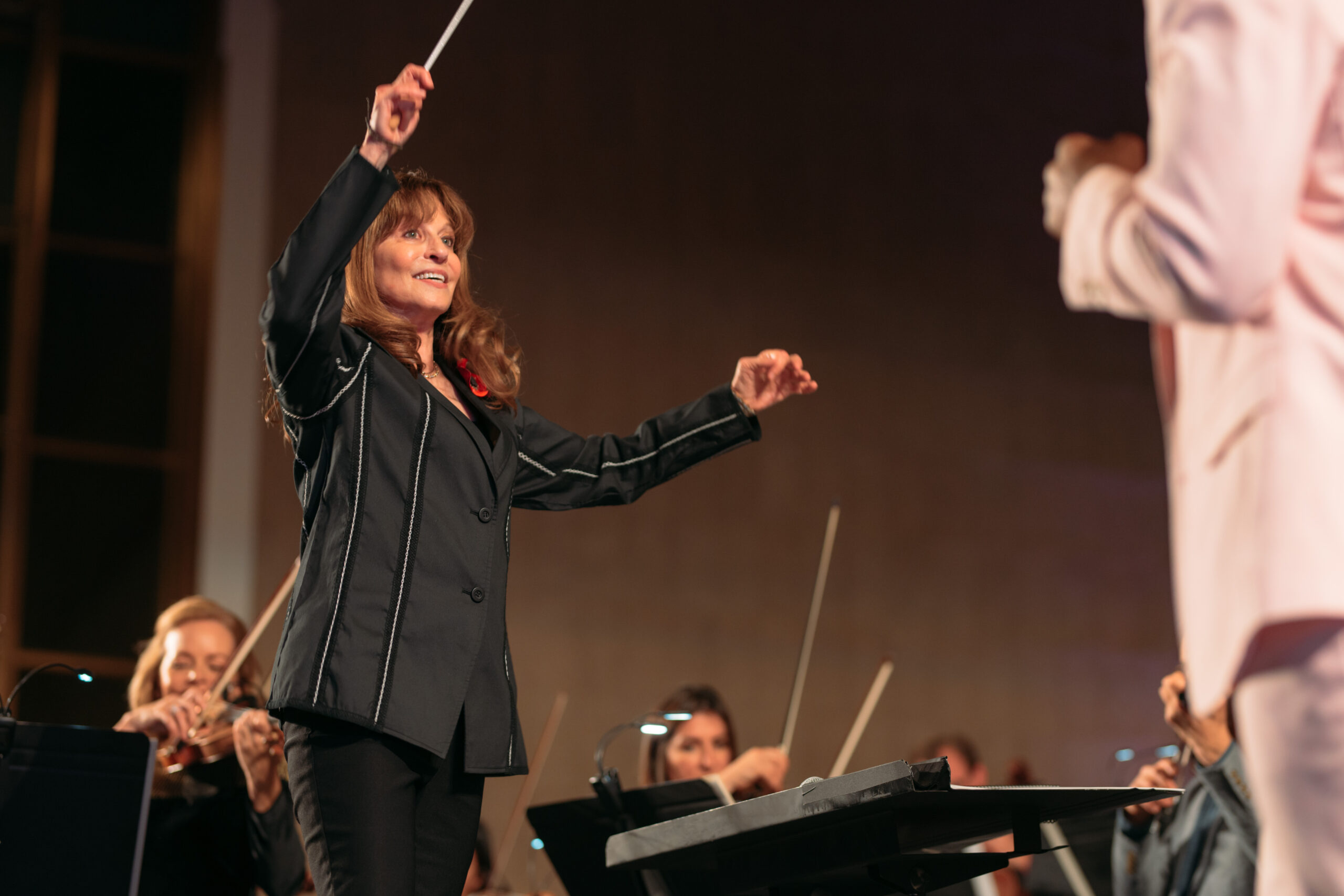
QUINCY’S WORLD
The New Founding Father of American Music
with vocalists Vanessa Bryan and Brandon Victor Dixon
March 5-8, 2026
The Wallis Annenberg Center for the Performing Arts,
9390 N. Santa Monica Blvd., Beverly Hills, CA 90210
Dates & Times:
March 5 & 6 @ 7:30 pm
March 7 @ 2:30 pm & 7:30 pm
March 8 @ 7:30 pm
ADMISSIONS FOR QUINCY’S WORLD:
- To learn more, please visit http://www.muse-ique.com/membership.
- MUSE/IQUE membership begins at $350 and MUSE/IQUE members receive complimentary admission to all MUSE/IQUE events.
- Admission for non-members starts at $75 for a single admission or $100 for a trial membership with admission to MUSE/IQUE’s next three events.

More about Quincy Jones:
Grandson of a Mississippi slave, Quincy Jones was born in Chicago in 1933 and then brought up in Seattle. By age 13, he had tried all of the instruments in his school band before choosing the trumpet. There he befriended a local singer who was three years older than him – Ray Charles. Jones said, “At school, we were playing John Philip Sousa and classical concert-band music. We’d play dinner music at the white tennis clubs, and later we’d play hard rhythm and blues at the black social clubs. Then we’d go to the red-light district and play for strippers and comics, and then play bebop into the early morning-it was the greatest life in the world.”
Just out of his teens, he toured with Lionel Hampton, performing on trumpet, leading to his becoming one of the most prolific music arrangers in the business and his work has been heard on music featuring Count Basie, Tommy Dorsey, Gene Krupa, Sarah Vaughn, Duke Ellington, Dinah Washington, Ray Charles, Clifford Brown, Oscar Pettiford, and Cannonball Adderley.
He joined Dizzy Gillespie’s big band in 1956 and eventually became musical director on Gillespie’s US State Department tours of the Middle East and Latin America. He spent time in Paris, including recording Jacques Brel and Charles Aznavour. He returned to the United States and joined Mercury Records, became its music director in 1960, and, in 1964 ,when he became a Vice President there, he was one of the first African Americans to hold a high position at an American record label.
Jones has had a spectacular influence on American culture for more than 50 years. Artists from every era of American popular music, from bebop to hip hop, have turned to Quincy Jones to help to achieve their best: Dinah Washington, Sarah Vaughn, Nat King Cole, Count Basie, Frank Sinatra, Dizzy Gillespie, Andy Williams, Peggy Lee, Lesley Gore, Aretha Franklin, Ringo Starr, Michael Jackson, Chaka Khan, Donna Sommers, George Benson, and Barbra Streisand. At one point, Ebony Magazine named Jones the most powerful black person in Hollywood.
As a creator of new music, he has shuffled pop, soul, hip-hop, jazz, classical, African and Brazilian music into a dazzling fusion all his own. In 1964, when he was named a vice-president of Mercury Records, he became the first African American to hold a high-level executive position In a white-owned record company. And after composing the score for Sidney Lumet’s “The Pawnbroker” in 1965, he was the first black composer embraced by the Hollywood establishment.
His film career began in 1964, and his notable scores include “In Cold Blood,” “In the Heat of the Night,” “The Italian Job,” “Bob and Carol and Ted and Alice,” “Cactus Flower,” and “The Getaway.” He co-produced Steven Spielberg’s adaptation of Alice Walker’s “The Color Purple”, which was nominated for 11 Academy Awards. For television, Jones wrote the theme music for “Ironside” (the first synthesizer-based TV theme song), “Sanford and Son,” “The Bill Cosby Show,” and he won an Emmy Award for the mini-series “Roots.”
At the same time, his production and arrangements for the 1964 Frank Sinatra- Count Basie album “It Might As Well Be Swing” and the 1966 “Sinatra at the Sands” helped them to become huge best sellers. He also produced Sinatra’s “L.A. Is My Lady” album in 1984.
Jones worked for the A&M label from 1969 to 1981 and moved increasingly away from jazz toward pop music. During this time, he became one of the most famous producers in the world, his success enabling him to start his own record label, Qwest, in 1980. This work included several GRAMMY® Award-winning albums under his own name between 1969 and 1981, including “Walking in Space” and “You’ve Got It Bad, Girl.”
Jones was a major supporter of Dr. Martin Luther King. Jr.’s Operation Breadbasket, and after King’s death, he served on the board of Jesse Jackson’s People United to Save Humanity.
An ongoing concern throughout his life was to foster appreciation of African American music and culture and he helped form the Institute for Black American Music, which was instrumental in establishing a national library of African American art and music. Jones was also the founder of the annual Black Arts Festival in his hometown of Chicago.
He worked with Miles Davis, revisiting his 1950s orchestral collaborations with Gil Evans at the Montreux Jazz Festival in 1991, and conducting the orchestra for Davis’s last concert. He also ran his own record label, Qwest Records and was chairman and CEO of Qwest Broadcasting, one of the largest minority-owned broadcasting companies in the United States. Jones died at the age of 91 at this Bel Air home in November, 2024.
About the vocalists:
Born and raised in Alaska, Vanessa Bryan has emerged as one of Los Angeles’ most commanding and versatile vocalists—a voice that is both unmistakably raw and unshakably powerful. With a signature sound described as gritty yet sweet, tender yet explosive, Vanessa has carved out a reputation that rivals the most celebrated performers on the global stage.
Her career highlights read like a who’s who of modern music. Vanessa has shared the stage at Madison Square Garden, completed two world tours with Broadway icon Idina Menzel, electrified crowds at Coachella alongside RAYE, and headlined the legendary Glastonbury Festival with The Killers. She received industry-wide recognition with a Grammy nomination for her work on Lady Gaga’s record “Babylon” and has supported Gwen Stefani on tour, as well as on her televised “Christmas Special.”
Beyond the concert stage, Vanessa’s voice has been trusted at the highest levels—most notably when she was selected as the vocalist for Naomi Biden’s wedding reception at the White House, a performance that underscored her reputation as one of the most sought-after vocalists of her generation.
Her artistry extends beyond performance into mentorship and creative development. As a Vocal Coach and Casting Creative for Kidz Bop, Vanessa has guided the next generation of rising stars, shaping young voices with the same precision and passion she brings to her own craft. While her career spans some of the world’s most iconic stages, Vanessa remains deeply committed to the music itself—grateful for every opportunity to share her voice, and humbled by the chance to inspire, connect, and move others through song.
GRAMMY® Award winner Brandon Victor Dixon was EMMY Award-nominated as Judas opposite John Legend in NBC’s “Jesus Christ Superstar Live.” He most recently starred in FOX’s “RENT,” Amazon’s “Modern Love,” and as Terry Silver on the STARZ series, “POWER.” He starred on Broadway as David in Hell’s Kitchen, for which he won a GRAMMY® for the cast album, as Billy Flynn in Chicago, and starred as Aaron Burr in Hamilton.
Since his professional debut, originating the role of Adult Simba in The Lion King national tour (Cheetah company), Brandon has displayed his diverse abilities in a number of roles. Notably, he was nominated for a Tony Award for his role as Harpo in Broadway’s The Color Purple, a GRAMMY® nomination for his portrayal of Berry Gordy Jr. in Motown, The Musical, and he was nominated for Olivier, Drama Desk, Lucille Lortel, Outer Critics Circle, Drama League, and AUDELCO awards for his outstanding portrayal of Haywood Patterson in Kander and Ebb’s The Scottsboro Boys.
Brandon has appeared in concert with various ensembles and artists such as Burnt Sugar The Arkestra Chamber, Jennifer Hudson, Nathan Lane, Wynton Marsalis, Chita Rivera, Liza Minnelli, David Hyde Pierce, and Tony winners Levi Kreis, Kelli O’Hara, and Brian Stokes Mitchell. Other credits include ABC’s “One Life To Live,” NBC’s “Law & Order: Criminal Intent,” CBS’s “The Good Wife”, and NETFLIX’s “She’s Gotta Have It.”
Dixon is a graduate of Columbia University and a recipient of the University’s I.A.L Diamond Award for Achievement in the Arts — an honor he shares with Tony Kushner (Angels in America), Jeanine Tesori (Caroline, or Change) and Katori Hall (The Mountaintop, TINA on Broadway). His company WalkRunFly has produced multiple works, including the Tony Award-winning Hedwig and the Angry Inch starring Neil Patrick Harris. He is co-founder of The WeAre Foundation, a non-profit “Turning Art into Action”, and Qurator, the movie ratings app (available on iOS/ANDROID).
About MUSE/IQUE
MUSE/IQUE is a member-supported, nonprofit performing arts organization that creates transformative musical adventures and illuminates the music that shapes our lives. By reimagining the traditional format of the live classical orchestral experience, Artistic & Music Director Rachael Worby seamlessly blends musical performances with researched curation. Their mission is to build empathy and expand imaginations through transformative live events and strong partnerships with fellow nonprofit organizations in Pasadena and the greater Los Angeles area.
About The Wallis
Wallis Annenberg Center for the Performing Arts (The Wallis) was lauded by Culture Vulture: “If you love expecting the unexpected in the performing arts, you have to love The Wallis.” Broadway legend Patti LuPone, described the venue as “one of the best in the country, allowing for an unparalleled intimacy between [the artist] and the audience.”
Since its doors opened in 2013, The Wallis, located in the heart of Beverly Hills, CA, is a dynamic cultural hub and community resource where local, national, and international performers share their artistry with ever-expanding audiences. Distinguished by eclectic programming that mirrors the diverse landscape of Los Angeles and its location in the entertainment capital of the world, The Wallis has produced and presented nearly 500 theater, dance, music, film, cabaret, comedy, performance arts, and family entertainment programs, boasting nominations for 79 Ovation Awards and nine L.A. Drama Critics Circle Awards, as well as six architectural awards.
The breathtaking 70,000-square-foot facility, celebrating the classic and the modern, was named after philanthropist Wallis Annenberg, who’s original $25-million-dollar donation was instrumental in transforming the beloved former 1934 Beverly Hills Post Office (on the National Register of Historic Places) into an arts complex. Designed by acclaimed architect Zoltan E. Pali (SPF: architects), the restored building features one of two sets of eight towering original WPA frescos, these by Charles Kassler, remaining in the entire California Federal Building system. The Wallis’ lobby, now known as Jim and Eleanor Randall Grand Hall, serves as the theater’s dramatic yet welcoming entryway to the contemporary 500-seat, state-of-the-art Bram Goldsmith Theater; the 150-seat Lovelace Studio Theater; an inviting open-air plaza for family, community and other performances; and GRoW @ The Wallis: A Space for Arts Education, where learning opportunities for all ages and backgrounds abound. Together, these elements embrace both the region’s history and its future, creating a performing arts destination for Los Angeles area visitors and residents alike.
Daphna Nazarian is Chair of The Wallis’ Board of Directors.


[…] QUINCY’S WORLD (THE SEASON OPENER)Celebrating the legacy of composer and producer Quincy Jones, this multi-date opening runs March 5–8 at The Wallis in Beverly Hills. Featuring vocalists and the Muse/ique Orchestra, the program highlights Jones’s genre-spanning work — from pop classics to jazz and film scores. […]