 Pauline Adamek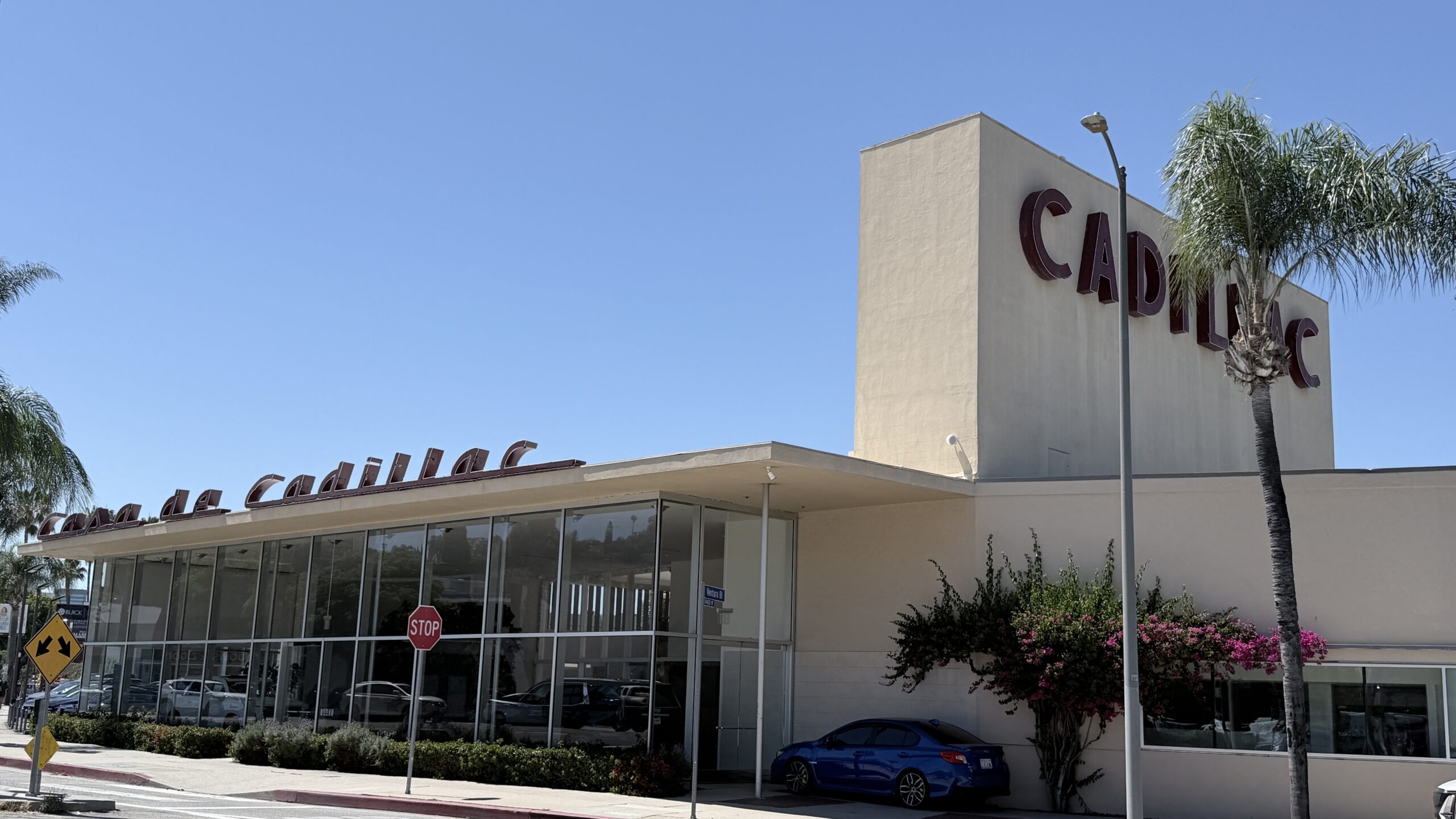
The atomic age, the space race, the prospective colonization of the moon—the post-war years of the mid-Twentieth Century ushered in a thrilling era, shimmering with the promise of interstellar exploration. All this excitement was reflected in contemporary architecture, characterized by a futuristic visual style that symbolized motion.
Suddenly, everyone was in love with curvy boomerang shapes, sleek flying saucer domes, whirling atoms and elegant, sweeping parabolas. Dubbed ‘Googie’ architecture, this quirky form of modern building design placed emphasis on curvaceous, upswept rooflines, wacky geometric shapes and the fusing of steel, neon and glass.
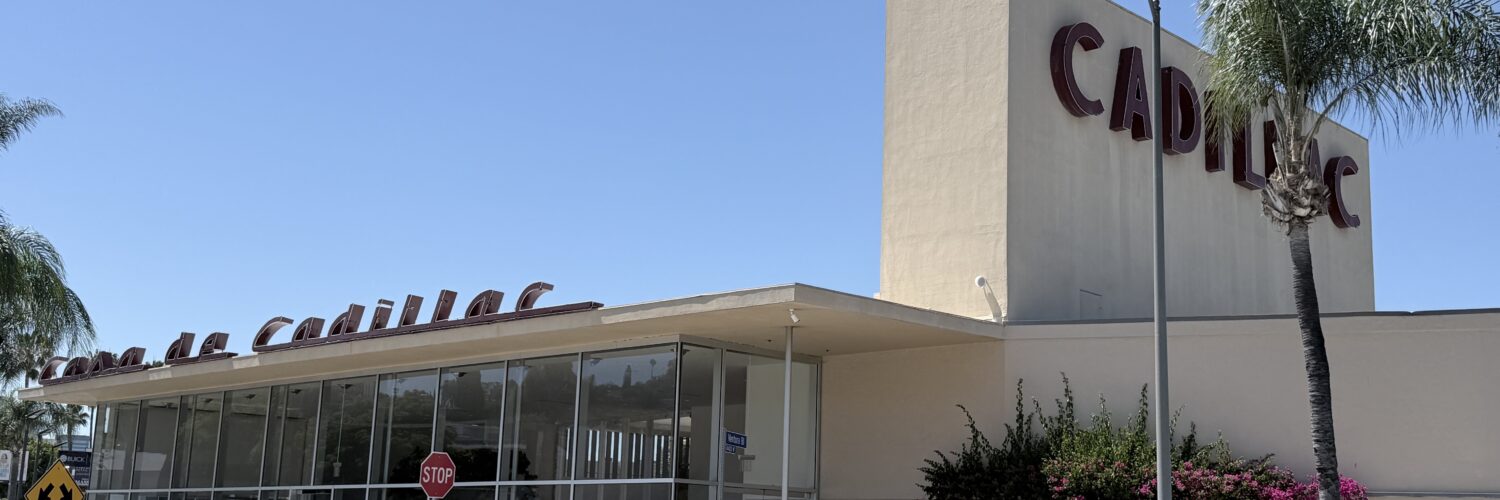
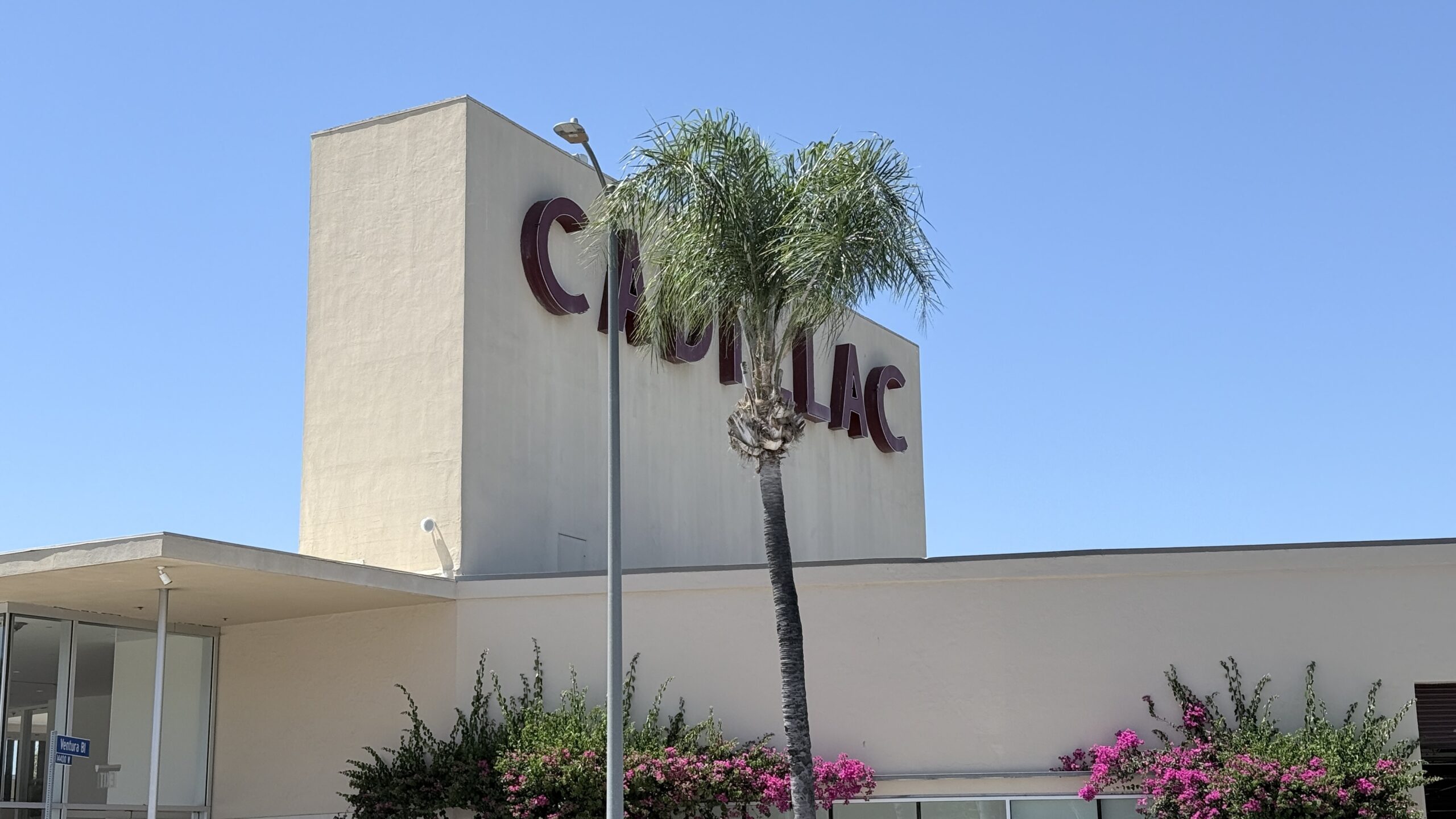
One location where the car culture met the jet-set Space Age was—and still is—Casa de Cadillac, a glamorous fixture on Ventura Boulevard, in Sherman Oaks, ever since it opened as a branch of Don Lee Cadillac in the spring of 1949. Like Bob’s Big Boy diner in Burbank or the flying saucer-like ‘Theme Building’ at the center of LAX, the sleek and retro architectural style of Casa de Cadillac exemplifies the ‘populuxe’ aesthetic.
A 21st century renovation was undertaken to restore the charm of this unique and family owned and operated landmark venue. No mere car sales yard, with its two-story polished glass box showroom, Casa de Cadillac remains a spectacular display case for luxury automobiles, these days including Buick and GMC as well as Cadillac vehicles.
Note: This article dates back to 2013.
The (then) presiding General Sales Manager of Casa Automotive Group, Greg Anderson, explained how it was the Cadillac executives who sparked the renovation. “The company was going through a renaissance of their own, including a whole new facility image program,” he recalled.
Over the course of two-and-a-half years, the painstaking restoration preserved the best aspects of the dealership. That included the original 1949 terrazzo tile flooring, a luxe touch that is unique to this site.
In 1994, the Northridge earthquake took out almost all the massive picture windows of the building. Explained Anderson, “Back then, they were replaced by 8 foot by 4 foot glass panes as that was all that was available. Now we have restored these beautiful big 8 foot by 8 foot windows with ¾ inch glass that’s almost soundproof. It’s unbelievable! It opens it up so much more,” he marveled.
Also preserved was the original lanai-style courtyard, with the addition of 3,000 pound piece of Vietnamese basalt – basically a massive igneous boulder – forming a gentle fountain. Extolling the virtues of this “three little acres of heaven,” Anderson added, “This place is the same, only better, because we’ve modernized it quite a bit. We completely updated the service drive, which is a customer touchpoint.” Business offices were relocated to another part of the building and a new customer lounge area was put in their place, just off the main showroom.
Anderson revealed that his dealership embarked upon a “huge fight” to preserve the graceful neon signage. “That’s not Cadillac’s script anymore. But they saw the value of it and allowed us to keep it.”
The chic car dealership was designed in 1948 (completed in 1949) by Randall Duell, a USC trained architect and scenic designer for Hollywood studio pictures. His vision for Casa de Cadillac was governed by the aesthetics of ‘streamline moderne’—pure horizontal lines and aerodynamic curves—that he topped with an iconic monument sign. Eighty-two feet of crisp, blazing white neon lettering spelled out ‘Casa de Cadillac’ in exactly the same script that was displayed on the front fender of the 1949 Coupe de Ville. In fact, this venue remains the last place in the country that you can still see that ancient Caddy script; today all other dealerships sport Cadillac’s later, more cursive and curlicue design.
Anderson said he’d heard numerous stories of longtime Valley residents who fondly recall visiting the swank dealership with their grandparent, then growing up to buy their own car there. Apparently a popular hangout for young studio executives on Sunday mornings, you could take your caddy to next door’s car wash, get your shoes shined and chat to colleagues while catching up on the latest edition of Variety or Hollywood Reporter. Back in the fifties, the name was brutally anglicized by many to sound more like “Cassidy” Cadillac than its true name.
The corner of Beverly Glen and Ventura became known as “The Casa Corner” as there were three connected businesses: Casa de Cadillac, Casa de Petrol (a gas station, now a floral shop), and Casa de Cascade Car Wash, complete with a rock pool and cascading waterfall out front (later the Handy J wash). Someone even tried to cash in on the name by opening a Casa Burger joint across the road. Sadly, Casa de Petrol is infamous for being the place where James Dean fueled up his Porsche 550 Spyder on the day of his death, September 30, 1955.
James Wilson was the president of Casa de Cadillac from 1963 until 2008, when he passed ownership to his daughter and son-in-law, Susan and Howard Drake.
Back in 2013, Howard Drake ran daily operations for Casa Automotive Group and Casa de Cadillac. Echoing Anderson, Drake dryly commented, “Those windows bugged the heck out of me for a little over two decades.” He enthusiastically pointed out modern innovations, such as the roof of the service center and workshop that is tiled with solar paneling. “That’s 35,000 square feet—almost an acre.” These days approximately 129kW of solar power is captured and used to run the facility, even supplying excess electricity back to the grid. Explaining the guiding light of the restoration, Drake divulged, “One thing that was extremely important to the conservancy was the plane from outside into atrium—there are no elevation changes. From outside to inside to outside, both the floor and the ceiling stay on the same plane, which is rare in a lot of buildings.”
A masterpiece of mid-century design, Casa de Cadillac endures as an architectural treasure in the San Fernando Valley.