

 Pauline Adamek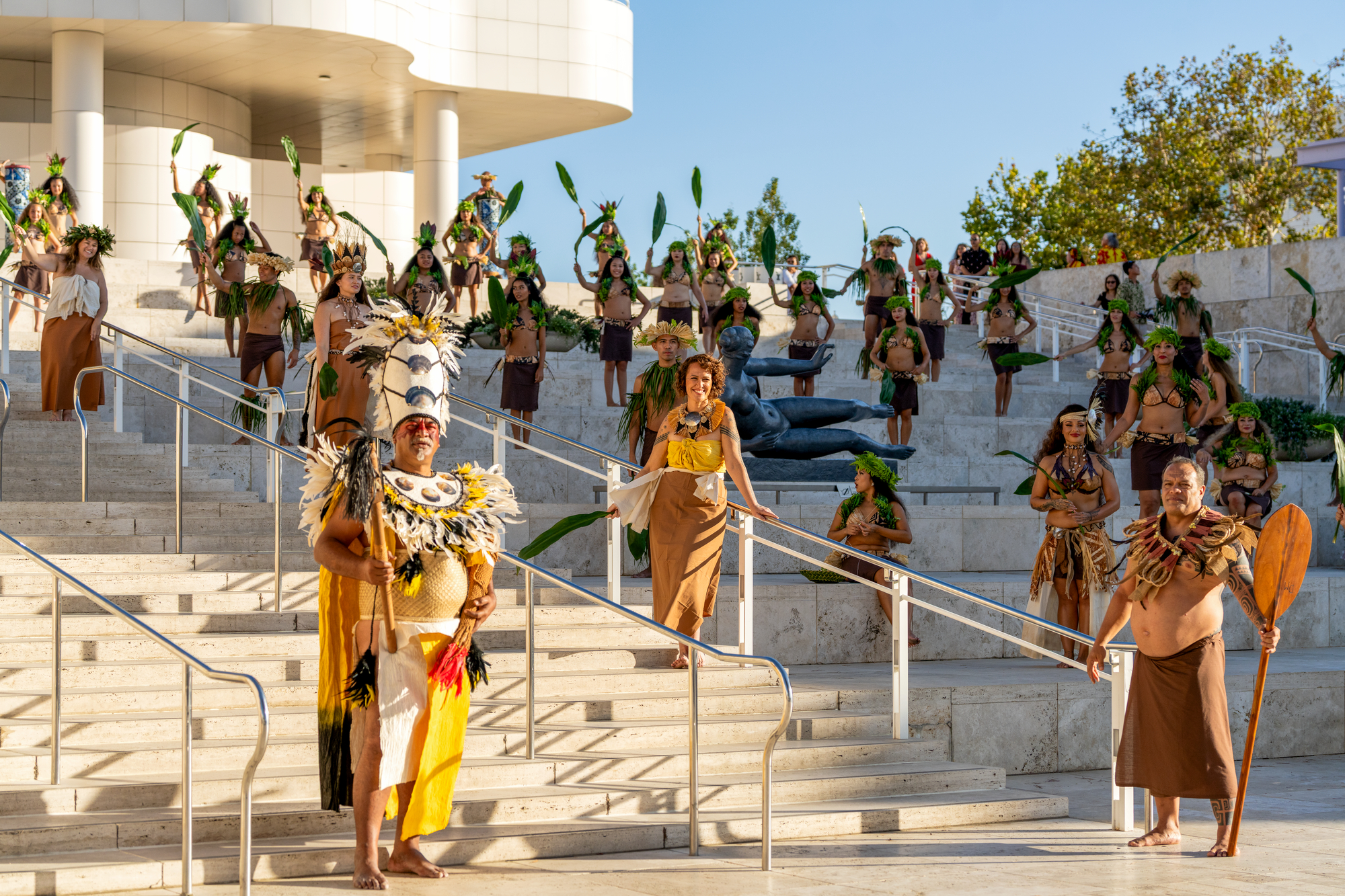
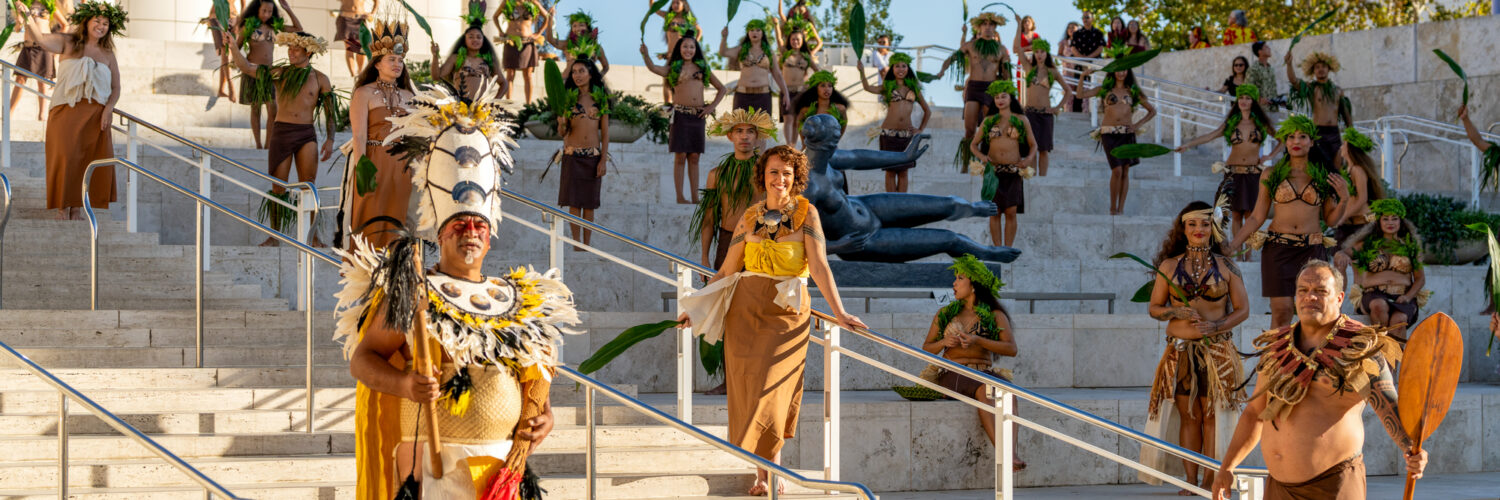
Invited guests were on hand last week at the Getty Center for the private blessing ceremony of the 18th century painting Portrait of Mai (“Omai”) where President of French Polynesia, Moetai Brotherson, as well as other VIPs were in attendance. Over seventy artists from the Polynesian community gathered to welcome us and to activate the space with dance, music, and cultural traditions.
Above photo: Te Ara O Mai Grand Opening Ceremony at the Getty Center; Image © 2026 J. Paul Getty Trust.
Greeted by chants and broad smiles, we heard drums, watched dancers, intoned a prayer – all under the balmy breezes with warm light casting shadows across the travertine marble concourse.
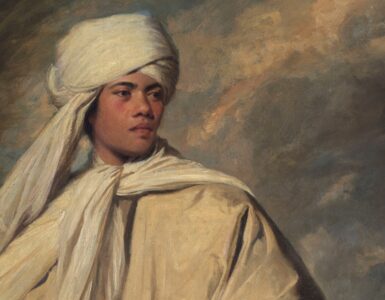
After 250 years, this astonishing portrait has arrived at the Pacific: the ocean that its subject called home. Traveling from the National Portrait Gallery in London to the J. Paul Getty Museum, you can now witness the US debut of Sir Joshua Reynolds’ Portrait of Mai, a compelling painting of the first Polynesian visitor to Great Britain.
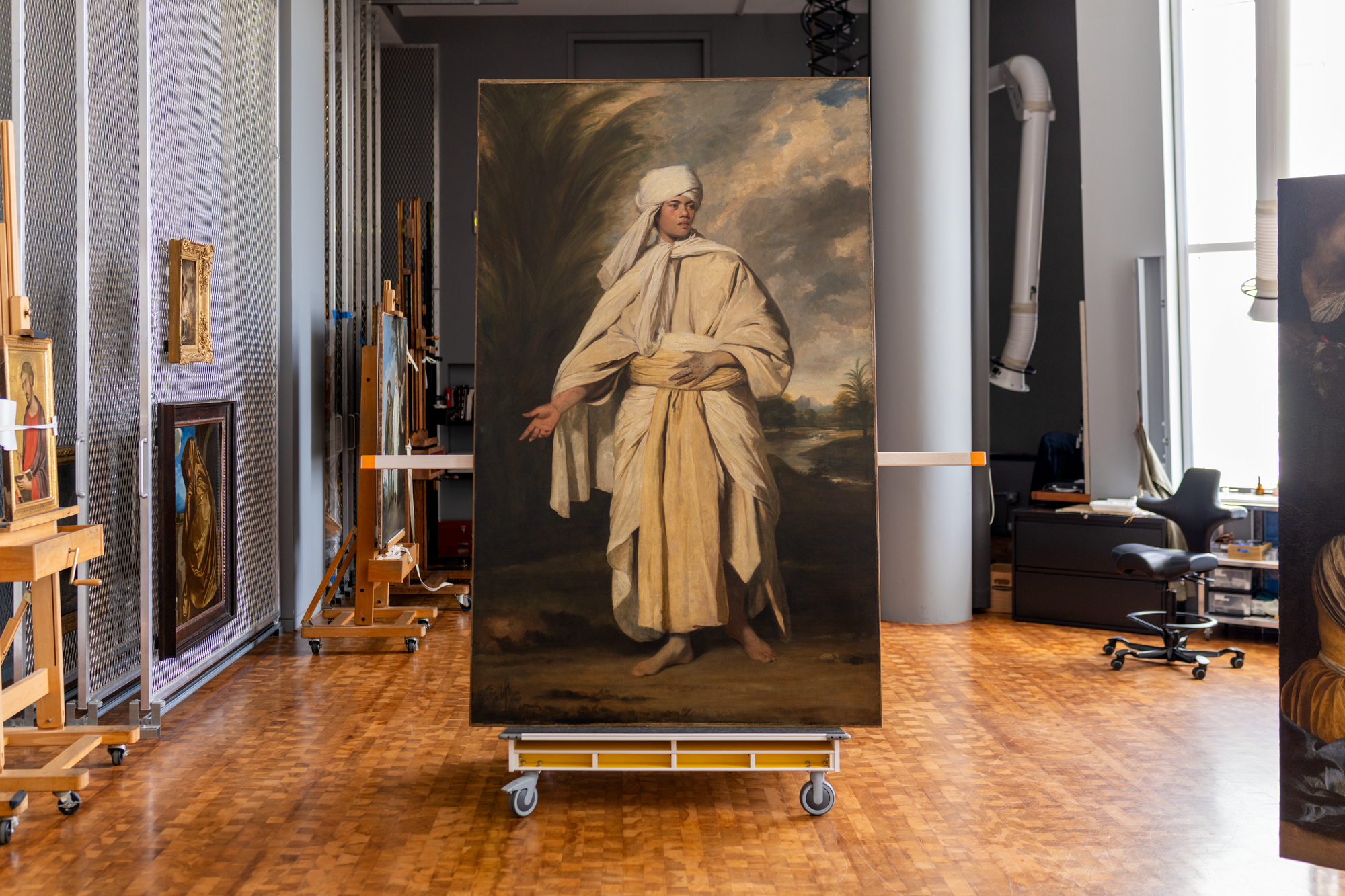
Joshua Reynolds’ Portrait of Mai and 18th-Century Portraiture will be on view at the J. Paul Getty Museum through March 14, 2027.
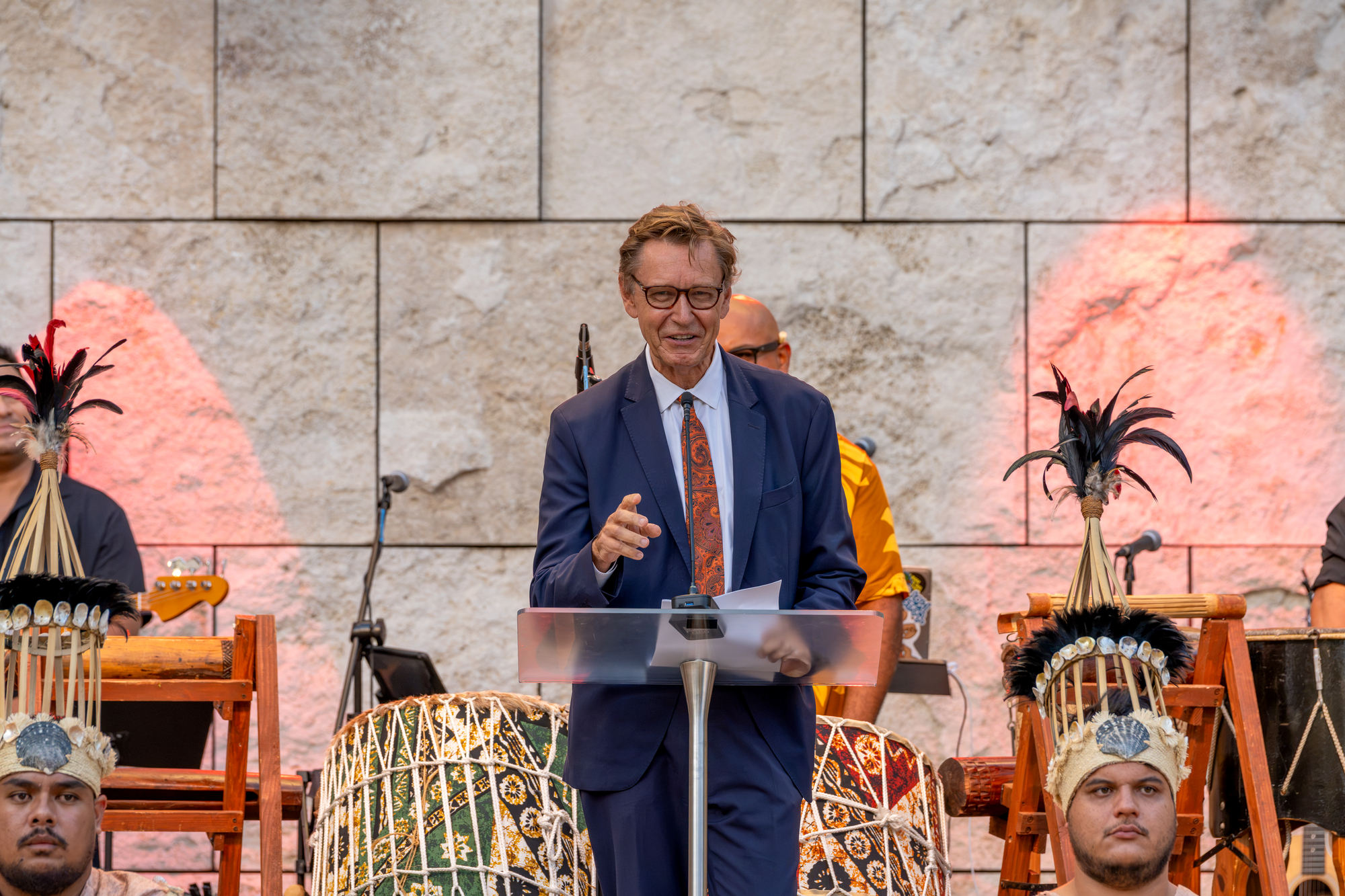
Opening remarks were made by Dr. Timothy Potts — Maria Hummer-Tuttle and Robert Tuttle Director of the J. Paul Getty Museum.
“The story of tonight’s exhibition begins with Mai, a Tahitian dignitary who, in 1773, joined Captain Cook’s second return voyage from the Pacific to London. Mai’s intention was to secure armaments for a dispute with a neighboring island. But upon arriving in London, he soon found himself feted as a social celebrity, paraded around English aristocratic circles, and even meeting King George III.
At the end of his two-year stay, Mai was invited to sit for his portrait by Sir Joshua Reynolds, the preeminent English portraitist of his day. The result was one of Reynolds’ greatest masterpieces: a magnificent full-length painting that would be a highlight in any major museum, and that you will see for the first time here tonight. And yet the portrait’s artistic qualities are not the only, or even the principal, source of the painting’s fame and importance. That lies in its intertwining of European and Polynesian worldviews — cultural, historical, and ideological — that have made it so compelling, but also contested.
Reynolds shows Mai against a tropical landscape, his hands richly tattooed and dressed in a tapa cloth, rose, and headdress, all signaling his Polynesian identity. At the same time, however, Reynolds adopts the stance and gesture of an ancient Greek or Roman sculpture, a common classical device frequently used to evoke heroic or noble figures.
Mai’s early years, and the two years after he returned with Captain Cook to Polynesia, are a story that cannot be passed over without feeling that he was celebrated more as an exotic curiosity than as the community dignitary he really was.
Those who met him in London commented on his noble demeanor and his rising command of English. We can only speculate on what Mai may have thought of all these hosts and their privileged lives in the center of a great empire — no doubt it must have been a lot to take in.
After Reynolds’ death, Mai’s portrait remained in private collections for over 250 years, until its joint purchase in 2023 by the National Portrait Gallery in London and the Getty here in Los Angeles.
The challenge of acquiring such an important painting was not only its cost. The NPG had raised half the purchase price, and the Getty funded the other half, under an agreement with Mai and henceforth to spend equal time in each of these now two homes.
More importantly, though, we needed to ensure that robust programs of conservation, education, research, and public engagement would be implemented in both museums, so as to have the greatest impact on our audiences.
So this is the beginning, not the end, of years of future study and re-contextualization of Mai’s portrait that will need to take place not only in Britain and French Polynesia, but also here in California and beyond.
I’m very pleased and feel very privileged that our close partner and collaborator in all of this has been Victoria Siddall, the director of the National Portrait Gallery in London.”
Portrait of Mai (“Omai”)
Sep 15, 2026–Mar 14, 2027
Getty Center
Museum West Pavilion, Plaza Level
Portrait of Mai was purchased jointly by the J. Paul Getty Trust and the Board of Trustees of the National Portrait Gallery, London, 2023. Support provided to NPG by the National Heritage Memorial Fund, Art Fund and other generous supporters.
This exhibition is presented in English and Spanish. Esta exposición se muestra en inglés y en español.
About the Getty:
The J. Paul Getty Museum collects Greek and Roman antiquities, European paintings, drawings, manuscripts, sculpture and decorative arts to 1900, as well as photographs from around the world to the present day. The Museum’s mission is to display and interpret its collections, and present important loan exhibitions and publications for the enjoyment and education of visitors locally and internationally. This is supported by an active program of research, conservation, and public programs that seek to deepen our knowledge of and connection to works of art.
Visiting the Getty Center
The Getty Center is open Tuesday through Sunday, 10am to 5:30pm. The Getty Center is open until 8pm on Saturdays, year-round. It is closed Mondays, Thanksgiving, December 25 (Christmas Day), and January 1. Admission to the Getty Center is always free, but a reservation is required for admission. Make reservations online or at (310) 440-7300. Parking is $25, $15 after 3pm, and $10 after 6pm. The Getty Center is at 1200 Getty Center Drive, Los Angeles, California.

 Terry Morgan