


 Pauline Adamek
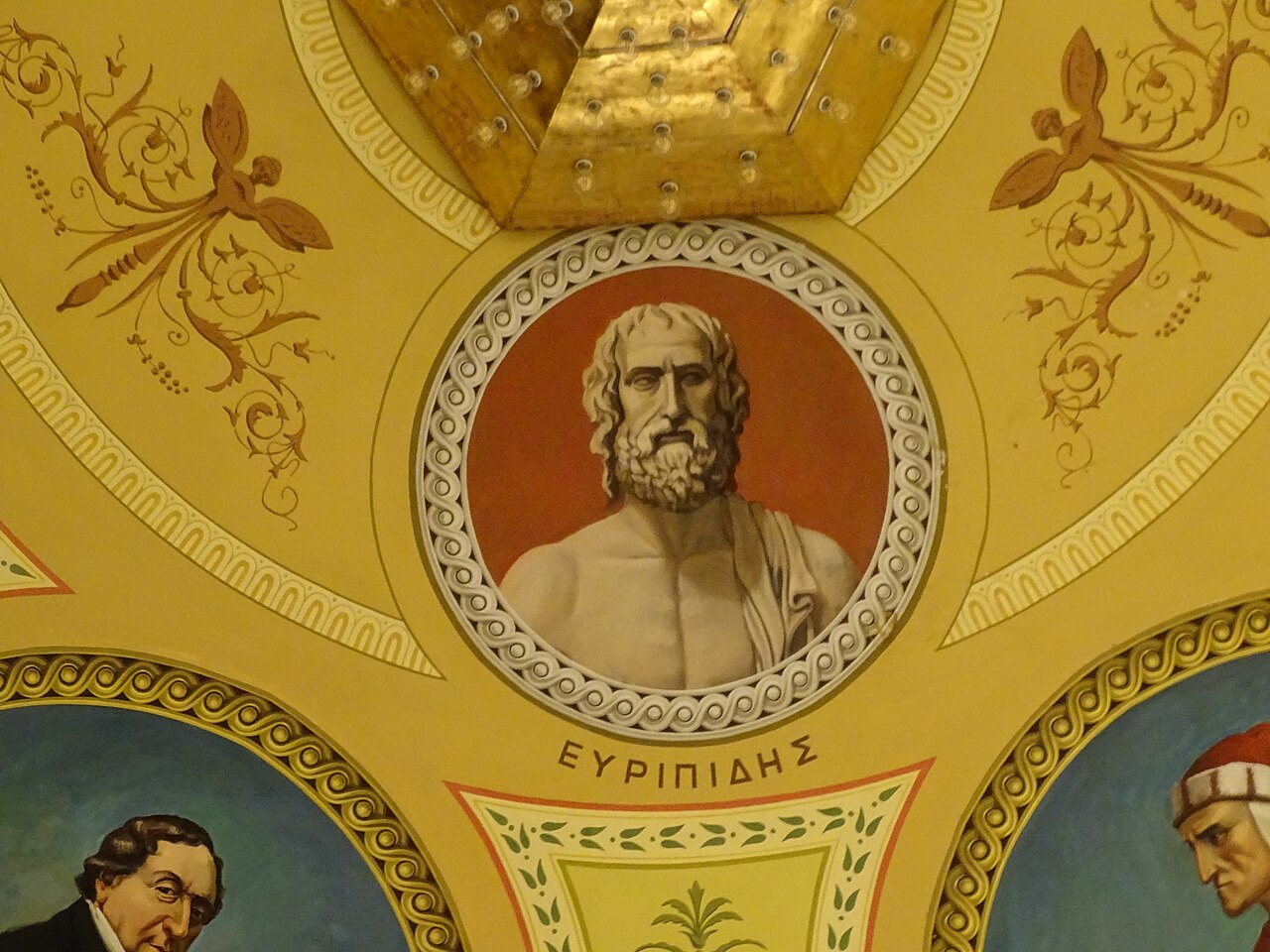
Euripides (c. 480 BCE – c. 406 BCE) was one of the three great tragedians of classical Athens, alongside Sophocles and Aeschylus. Writing during the height of Athenian cultural and political life, Euripides transformed the nature of Greek tragedy by introducing deeper psychological complexity, morally ambiguous characters, powerful female figures, and a questioning attitude toward traditional religious beliefs. His work pushed Greek drama away from purely heroic myth and toward a more human, emotionally realistic portrayal of people struggling with intense moral and psychological conflicts.
Biography
Euripides was born around 480 BCE, possibly on the island of Salamis or near Athens. His lifetime coincided with what is often called the Golden Age of Athens, a period marked by extraordinary achievements in philosophy, politics, art, and drama. He lived through the turmoil of the Peloponnesian War (431–404 BCE), a prolonged conflict between Athens and Sparta that deeply affected Athenian society and may have shaped the darker tone of many of his plays. Euripides wrote roughly ninety to ninety-five tragedies, although only eighteen or nineteen survive today in complete form. Late in life he left Athens and moved to the court of Archelaus I of Macedon in the Macedonian capital of Pella, where he died in 406 BCE. Ancient stories claim he was killed by hunting dogs, though historians generally consider this legend unreliable.
Legacy
Within the tradition of Greek tragedy, Euripides occupies a distinct place among the three major tragedians. Aeschylus, who lived from approximately 525 to 456 BCE, is often associated with grand, heroic themes and a strongly religious worldview. Sophocles, who lived from around 496 to 406 BCE, refined the structure of tragedy and emphasized balanced dramatic construction and noble moral dilemmas. Euripides, by contrast, brought a more skeptical and psychologically complex approach. His characters behave less like legendary heroes and more like recognizable human beings, driven by jealousy, anger, fear, and desire. In this sense, Euripides made tragedy feel less mythic and more realistic.
The Plays
Among the surviving works of Euripides are some of the most important tragedies in the Greek canon. His play Medea, first performed in 431 BCE, tells the shocking story of a woman who murders her own children to punish her unfaithful husband. Hippolytus (428 BCE) explores destructive passion and divine revenge through the tragic love of Phaedra for her stepson. The Trojan Women (415 BCE) portrays the suffering of women after the fall of Troy and is often interpreted as a powerful anti-war statement. Other major works include Electra (c. 413 BCE), Ion (c. 414 BCE), Helen (412 BCE), The Bacchae (405 BCE), and Iphigenia in Aulis (405 BCE). Among these, Medea and The Bacchae are often considered his most powerful works. The latter dramatizes the terrifying power of the god Dionysus and the catastrophic consequences of denying divine authority.
Impact
Several qualities made Euripides revolutionary in the context of Greek drama. One of the most significant was his emphasis on psychological realism. Instead of portraying characters as simple embodiments of moral ideals, he depicted them as conflicted individuals struggling with difficult emotions and choices. In Medea, for example, the audience witnesses the heroine’s internal struggle before she commits the horrifying act of killing her children. This focus on inner conflict was far more intense than what appeared in earlier tragedies.
Focus on Female Characters
Euripides was also remarkable for his portrayal of female characters. Figures such as Medea, Phaedra, Hecuba, and Electra are among the most complex and memorable women in ancient literature. At a time when Athenian society placed strict limits on women’s public roles, Euripides presented female characters who express powerful emotions, challenge authority, and sometimes drive the entire tragic action. This aspect of his work likely shocked many members of his original audience.
The Gods
Another defining feature of Euripidean drama is its skeptical treatment of the gods. Earlier tragedians tended to present the gods as morally authoritative figures who upheld justice and cosmic order. Euripides often depicted them as arbitrary, cruel, or manipulative. In The Bacchae, for example, Dionysus orchestrates the brutal death of a king simply because he refuses to acknowledge the god’s divinity. This portrayal raises unsettling questions about divine justice and the nature of religious belief.
Euripides also showed sympathy for people marginalized within Greek society. His plays frequently focus on women, slaves, foreigners, and victims of war. The Trojan Women, in particular, depicts the suffering of defeated Trojan women after their city has been destroyed by the Greeks. Rather than glorifying victory, the play emphasizes the human cost of war and the suffering inflicted on the powerless.
Dramatic Techniques
In terms of dramatic technique, Euripides introduced several innovations. He frequently used a device known as deus ex machina, meaning “god from the machine.” In this technique, a deity appears near the end of the play—often lowered onto the stage by a mechanical device—to resolve the remaining conflicts of the plot. In Medea, for instance, the sun god Helios sends a chariot to carry Medea safely away after she commits her crimes. Euripides also commonly opened his plays with a prologue in which a character explains the background of the story directly to the audience. This method helped clarify complex mythological situations before the main action began. In addition, he reduced the traditional role of the chorus, allowing the main characters to dominate the dramatic narrative more strongly than in earlier tragedies.
Despite his later fame, Euripides was not particularly successful during his lifetime. At the dramatic festival known as the City Dionysia, where playwrights competed for prizes, he entered roughly twenty-two competitions but won only four victories. By contrast, Sophocles is believed to have won around twenty-four times. Many Athenians considered Euripides too intellectual, too cynical, and even disrespectful toward traditional religion.
Figure of Fun
His controversial reputation made him a frequent target of satire. The comic playwright Aristophanes repeatedly mocked Euripides in his comedies, most famously in The Frogs, first performed in 405 BCE. In this play, Euripides and Aeschylus compete in the underworld to determine who is the superior tragedian, reflecting the lively cultural debates surrounding dramatic art in Athens.
Over time, however, Euripides became the most influential of the three great tragedians. His works strongly shaped later literature and drama. Roman playwrights such as Seneca the Younger drew heavily from his tragedies. His psychological depth also influenced major European dramatists including William Shakespeare and Jean Racine. In the modern era, thinkers such as Sigmund Freud found in Euripides’ characters a powerful exploration of the human psyche.
An Enduring Legacy
Today many scholars regard Euripides as the most modern of the Greek tragedians. His plays explore complex psychological motivations, moral ambiguity, social criticism, and the tension between rational order and emotional chaos. His willingness to question religious authority and to portray deeply flawed characters gives his work a strikingly contemporary quality. More than two thousand years after they were written, Euripides’ tragedies continue to challenge audiences with their intense emotional power and their probing examination of human nature.
Euripides was born around 480 BCE and died in 406 BCE. He wrote approximately ninety tragedies, of which eighteen or nineteen survive today. Through his psychological realism, controversial themes, and bold reinterpretations of traditional myth, he transformed Greek tragedy and left a lasting influence on the development of Western drama.
A Deeper Dive
The Bacchae by Euripides: Plot, Themes, and Significance
The Bacchae, written by Euripides and first produced around 405 BCE, is one of the most powerful and unsettling works of ancient Greek tragedy. The play explores the consequences of denying divine power and the dangers of suppressing the irrational forces within human nature. Set in the city of Thebes, the story follows the arrival of Dionysus, the god of wine, ecstasy, and ritual frenzy, and his calculated revenge against those who refuse to recognize his divinity.
Plotline
At the beginning of the play, Dionysus returns to Thebes disguised as a mortal. Although he is the son of Zeus and the Theban princess Semele, many citizens of the city refuse to believe he is truly a god. Members of his own family have publicly denied his divine status, claiming that Semele falsely attributed her pregnancy to Zeus. Determined to prove his power and punish those who insult him, Dionysus spreads his cult through the region. The women of Thebes, under the influence of his supernatural force, abandon their homes and gather in the mountains to perform ecstatic rites as followers known as the Bacchae.
The main opponent of Dionysus is Pentheus, the young king of Thebes and grandson of Cadmus, the city’s founder. Pentheus represents civic order, authority, and rational control. He hears reports that the women in the mountains are dancing wildly, carrying snakes, and engaging in mysterious rituals. To him, these accounts suggest moral disorder and a threat to social stability. Refusing to acknowledge Dionysus as a legitimate god, Pentheus resolves to suppress the new cult. When the disguised Dionysus arrives in the city, Pentheus orders his arrest, unaware that he has imprisoned the very god he is trying to oppose.
Dionysus allows himself to be captured but quickly demonstrates his supernatural power. The palace trembles as if struck by an earthquake, and the god easily escapes confinement. Instead of immediately destroying Pentheus, Dionysus chooses to manipulate him psychologically. He gradually persuades the king that the best way to expose the Bacchae is to spy on their rituals in the mountains. Pentheus becomes curious and agrees.
To avoid being recognized, Dionysus convinces Pentheus to disguise himself as a woman. The transformation is humiliating and symbolic. The rigid king who attempted to control the Dionysian cult now becomes part of the world he tried to suppress. Dionysus dresses him in Bacchic clothing and leads him toward the mountains where the Bacchae are gathered.
Once there, Dionysus places Pentheus in a tree so that he can secretly watch the rituals below. At that moment the god reveals the king’s presence to the Bacchae, who are in a state of divine frenzy. Under Dionysus’s influence they believe they have discovered a wild animal spying on them. The women rush forward and attack. Leading them is Agave, Pentheus’s own mother. In their collective madness the Bacchae tear Pentheus apart with their bare hands in a ritual act known as sparagmos, the violent dismemberment associated with Dionysian worship.
Agave triumphantly carries her son’s severed head back to Thebes, believing it to be the head of a lion she has killed during the hunt. Only after returning to the city does the divine madness begin to fade. Her father Cadmus gradually helps her realize the truth. As she looks at the head she is carrying, Agave finally understands that she has killed her own son. The moment of recognition is one of the most horrifying scenes in Greek tragedy.
At the end of the play, Dionysus appears openly in his divine form. He declares that the destruction of Pentheus and the suffering of the royal family are justified punishments for denying his divinity. Agave is banished from Thebes, and Cadmus and the rest of the family face further misfortune. Dionysus then departs, having demonstrated that no mortal can challenge the authority of a god without catastrophic consequences.
Themes
The themes of The Bacchae are complex and deeply unsettling. One of the central ideas is the conflict between rational order and irrational instinct. Pentheus represents discipline, law, and the structures of civilization. Dionysus represents ecstasy, emotion, and the primal forces that exist beneath social order. Euripides suggests that human society cannot simply eliminate these forces. When suppressed completely, they may return in far more destructive forms.
The play also presents an ambiguous and troubling portrayal of divine power. Dionysus is not merely a joyful god of celebration. Instead, he is calculating, manipulative, and merciless. He carefully engineers Pentheus’s destruction and shows little compassion for the suffering he causes. This portrayal reflects Euripides’ broader tendency to question traditional religious assumptions and to present the gods as powerful but morally unpredictable.
Another important theme is the fragility of human identity and civilization. Throughout the play, the boundaries that define social life collapse. Respectable women become violent hunters in the wilderness. A king disguises himself as a woman in order to spy on forbidden rituals. A mother becomes the killer of her own child. These transformations suggest that beneath the surface of civilized life lie powerful instincts that can erupt when released.
Today The Bacchae is widely regarded as one of the greatest tragedies of ancient Greece and one of Euripides’ most profound works. Its exploration of religion, psychology, and social order continues to resonate with modern audiences. The play’s disturbing conclusion—where a god calmly justifies the destruction of an entire family—forces viewers to confront the unsettling possibility that the forces shaping human life may be far more dangerous and unpredictable than reason alone can control.
A Darker Interpretation
There is also a darker interpretation that many scholars see beneath the surface of the play. Some believe The Bacchae reflects deep anxieties within Greek society itself, particularly about the instability of democratic life in Athens during the late fifth century BCE. According to this interpretation, the Bacchae’s collective frenzy resembles the dangerous power of mass emotion within a political community. Just as the women of Thebes become a violent mob under Dionysus’s influence, democratic crowds could be swept into destructive decisions by passion, persuasion, or charismatic leaders. From this perspective, the play is not only about religion and divine vengeance but also about the terrifying potential of collective human behavior.


 Terry Morgan