
 Pauline Adamek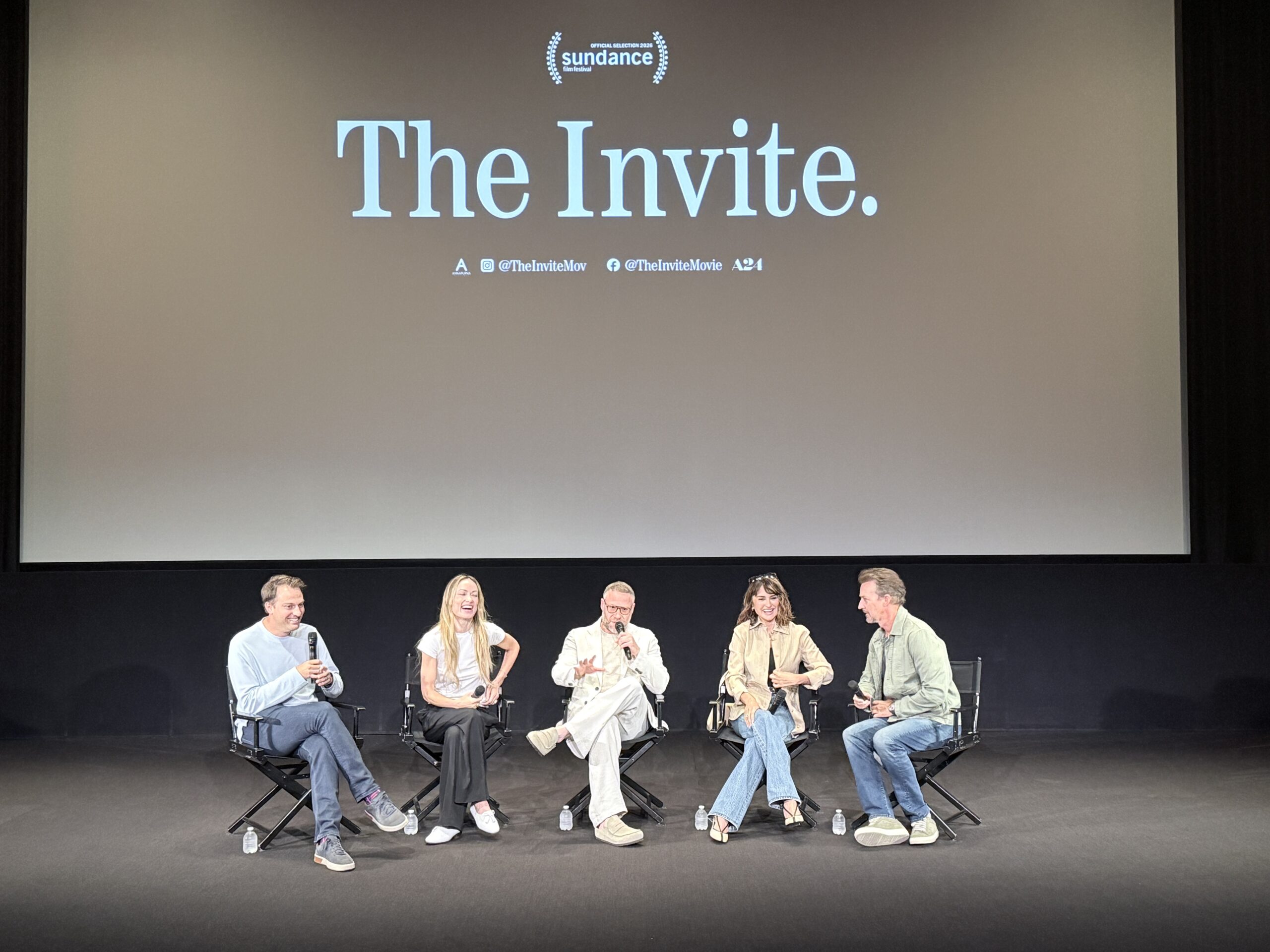
Olivia Wilde’s The Invite: “You Don’t Know What the Movie Is Until They Tell You”
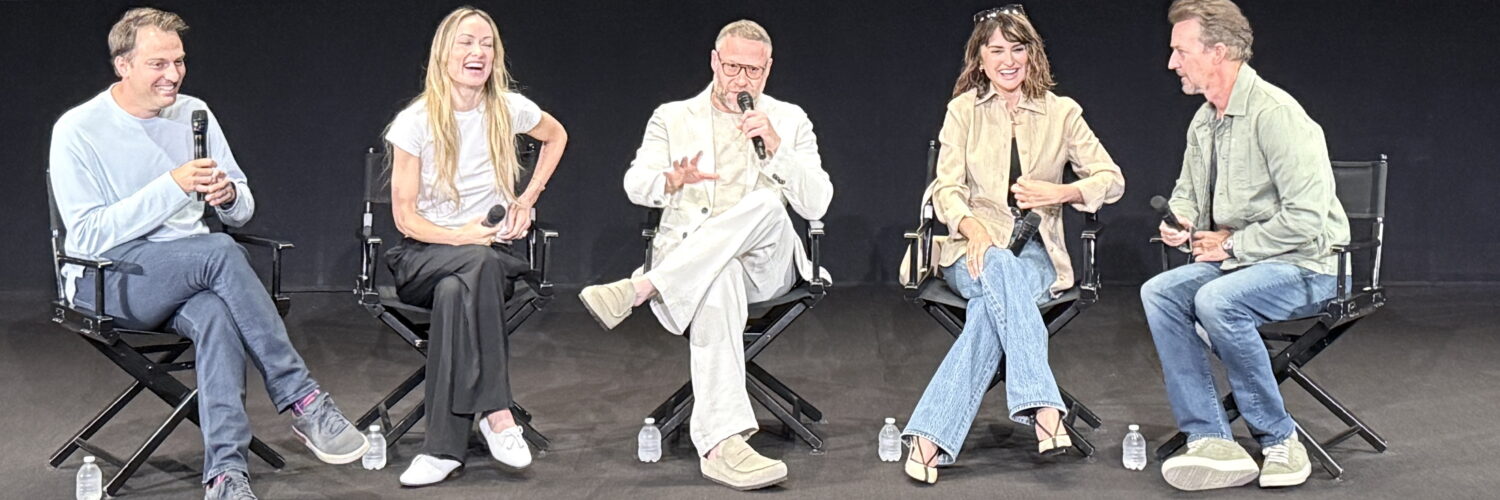
There is something appropriately unruly about the way The Invite came together. Olivia Wilde’s cringey comedy, starring Wilde alongside Seth Rogen, Penélope Cruz and Edward Norton, takes place largely over one increasingly chaotic dinner party. But the filmmaking process was almost as unconventional: the cast rehearsed together for two weeks, shot the film in chronological order and worked with Wilde to reshape the material as they went. The result is a movie that feels carefully constructed while retaining the looseness and surprise of live performance.
For Wilde, that freedom was the point. “Wanting to make this movie was really about knowing we could make this movie within the independent system, meaning we could do it the way we really wanted to do it,” the director says. “It was like an opportunity to make a movie the way I think that a lot of actors have always instinctually felt would probably lead to a good result: that you are given time to ingest the material together, to identify the intentions of everything, to workshop together with the writers, to really find the most honest way through it.”
The production was built around that idea. Rather than shooting scenes according to the conventional demands of production, Wilde wanted to shoot in sequence, allowing discoveries made early in the story to influence what came later. The cast had six weeks together, including two weeks of rehearsal, an unusually generous commitment from four actors at this level.
Wilde says. “All the surprises that we discovered together as we made it were permitted to become real because we weren’t asking permission.” That meant ideas could migrate directly from rehearsal into the finished film. “Hey, this interesting thing happened in our conversation in prep. Let’s put it in the movie,” Wilde recalls. “There are so many examples of that, but I think we all acknowledge that this is a great example of the kind of creative autonomy and authenticity you can achieve if you are actually just able to be creatively in control.”
A cast given room to explore
The film centers on two couples: Wilde and Rogen play Angela and Joe, whose marriage is struggling, while Cruz and Norton play their more sexually adventurous upstairs neighbors, Pína and Hawk. Wilde initially wasn’t certain she should play Angela herself.
Rogen, however, was convinced. When Wilde first discussed the film with him, another actress was attached to the role. Rogen thought the movie needed a particular kind of comic chemistry.
“When I read the script, I was like, ‘Oh, this has the potential to be something truly hysterical at times, and explosively funny if it’s immersive enough and kind of experiential enough,’” Rogen recalls. He had already worked with Wilde and felt they had the necessary rhythm. “We were just very funny together, I thought, and we screamed at each other very well.”
When the other actress dropped out, Wilde began suggesting alternative actresses for the part – apparently almost every actress in Hollywood except herself.
Eventually, the group confronted her about it. “There was a lot of, ‘What the fuck is wrong with you? Why do you keep sending us these random fucking names of other actors?’” Rogen recalls.
The pressure from her cast-mates ultimately forced Wilde to confront something she says many female filmmakers experience: the feeling that directing a film is one thing, but claiming a major acting role in the same film is somehow asking for too much.
“I think it’s such a battle for a woman already,” Wilde adds. “It really is just to get the trust of a lot of money people involved to let you direct a movie. Is there a sense of, ‘Will she be able to handle it? She’s just a lady?’”
The idea of giving herself the role triggered what Wilde describes as an “ingrained imposter syndrome.” She explains, “I was stopping myself until I had this incredible support from the whole cast,” she says. “I remember being like, ‘Penelope, are you cool with this? If I do this?’ She’s like, ‘Yeah, I was wondering why you weren’t doing it.’”
Rogen puts it more bluntly. “It was sheer pressure,” he confirms. “It was not a delicate process.”
Two weeks to find Pína
For Cruz, the rehearsal period was one of the most valuable parts of the entire production. The actors spent two weeks with Wilde and the writers, Rashida Jones and Will McCormack, dissecting the script and working out what the characters actually wanted.
“I could not believe it when I got the script,” Cruz says. “I read it, and I could not stop laughing for two hours.”
But the rehearsal wasn’t simply about memorizing dialogue. The cast became particularly focused on the ending and on Pína’s role as the evening turns unexpectedly therapeutic.
“We were so obsessed with that ending that, thank God, it was two weeks,” Cruz says. “We got intense in those two weeks, and finally we got to a place where we felt like, ‘We have it. We don’t have to wait for the miracle to happen on set.’”
The process also created the bond between the four performers. “The bonding that we have now comes, I think, a lot from those two weeks,” Cruz says. “I love being in a room with people that care as much as I do.
By the time shooting began, the actors had developed something approaching a small theater company. Then Wilde deliberately stopped controlling every detail. That distinction – preparation followed by freedom – became central to the movie. “I think that when actors are trusted to actually be able to tell the story and not just thought of as, like, to be controlled and sort of placated, a very different thing happens,” Wilde says. “People show up.”
She believes casting an actor means more than finding someone who fits a preconceived version of a character. “It can’t just be like, ‘I think you’re right for the role I have in my head.’ It has to be, ‘I’m casting you to trust you to tell me what this is,’ because you’re going to give this big chunk of yourself.”
Shooting the movie as it happened
Norton, who plays Hawk, was struck by the unusual freedom Wilde created. “I’ve been making films since 1995. I’ve made over 50 films. I’ve never shot a film in page order,” he says. “And had anything that was discovered build, you know, become a building block that informed the next and the next.”
By the second week, he says, the movie had become something substantially different from what they initially imagined. “At one point Olivia said, ‘We’re stitching the parachute on the way down, but it’s gonna open,’” Norton recalls. “It was this thrilling feeling of, like, we are changing this as we go on the basis of what happened yesterday.”
That approach extended to the characters themselves. Rather than rigidly defining every detail in advance, Wilde gave the actors space to bring their own experiences and ideas to their roles. “She essentially set us free to then discover, to improvise, a real set of interactions,” Norton says.
The result, he believes, can be seen in the actors’ reactions to one another. “When I watch it, one of the delights to me is I can see us surprising each other with lines and laughs and tears and vulnerability,” he says. “There are lots of reactions in the film that are us reacting to things that we didn’t know the other person had built into their idea of the character.”
Yet the apparent spontaneity was paired with considerable visual planning. Shot on 35mm film in a single principal location, The Invite uses mirrors, frames within frames and carefully designed compositions to make the confined setting feel expansive.
Norton was struck by the contradiction. “I really have never been involved in anything where a director created that much space and trust,” he says. “When you watch the film, you’re like, ‘That is so intentional. It looks so intentional.’ And to pull both of those things off is like a miracle.”
The scenes that weren’t in the script
Some of the film’s most revealing moments emerged almost accidentally. Rogen recalls that, in the original script, the couples didn’t split up in the way they eventually do. During rehearsal, Cruz suggested that her character and Rogen’s should spend time alone together.
“Originally, I just left and went and smoked weed alone,” Rogen says. “But Penelope was like, ‘It would be funny to have our characters alone together.’”
The new dynamic changed the movie. “We kind of actually like each other,” he says. “You see me kind of let my guard down a little bit.”
The scene then opened the door to possibilities that weren’t originally contemplated. “What if we really push it as far as it can go?” Rogen remembers the group asking. “All this was sort of happening in real time as we were making the movie.”
That experimentation also changed the film’s tone, making it at times funnier, more romantic and sexier than originally intended. For Wilde, that was precisely the point of trusting performers. “We just had to pay attention to it and trust it,” she says.
Finding a simpler ending
The film’s ending underwent perhaps the most significant evolution. Wilde describes the guiding principle simply: “It felt like it was about, like, saying less. We just kept having the instinct that we should say less.”
Rogen remembers that the original ending was considerably more elaborate. The final piano sequence emerged during the rehearsal process, and once they discovered it, he became convinced that everything else should serve that image. “As long as the movie ends like that, that is the ending,” he says.
The third act had initially been much bigger and louder, with more speeches, physical comedy and dramatic escalation. Gradually, the actors and Wilde stripped it back. “How do we strip everything away that seems big or seems like it’s trying to crescendo in a certain way?” Rogen recalls asking. The answer was to let the movie become quieter. “It’s nice if it sort of goes down,” he says. “It gets sort of sad and quiet and awkward, and we don’t know what to say to each other.”
Even the ending itself went through strange permutations. Wilde remembers that the rehearsal version ended with her character walking into the bedroom, followed by Rogen carrying a candle. “We were like, ‘That’s not us. That’s not Seth and me. We’re never doing that,’” she says.
For Wilde, the eventual restraint reflects the larger philosophy behind the production. A script doesn’t necessarily need to explain what a character is feeling. Sometimes the most revealing performance happens when the character cannot articulate it. “One of my favorite moments in the movie is when Joe wants to say to her, ‘I don’t feel that way about you, and I’m sorry, and I’m at a loss,’ and he can’t speak,” Wilde says. “He doesn’t have the words, and he keeps trying. And on the page, that looks like nothing is happening.”
In The Invite, that “nothing” is often where everything happens. The film’s greatest gamble was not simply allowing its actors to improvise, it was trusting them enough to discover that sometimes the most interesting thing they can do is stop trying to explain themselves.
As Wilde puts it: “You don’t know what the movie is until they tell you.”