
 Pauline Adamek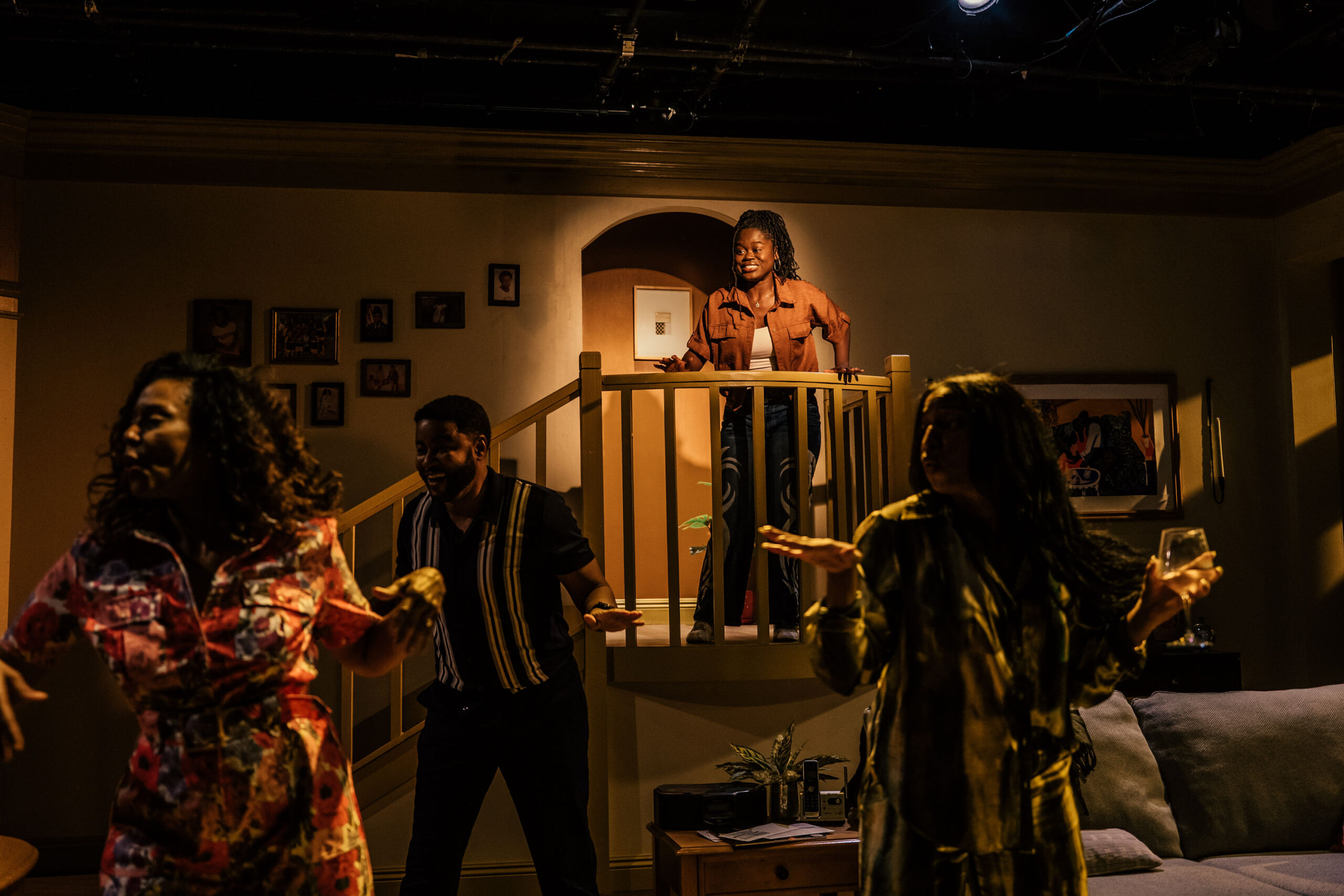
The Pulitzer-prize winning play by Jackie Sibblies Drury, Fairview, made its LA premier last night at Rogue Machine Theatre.
As this is clearly a play where the less you know about it the better, I am recommending you see it and then read my review as it may contain some spoilers. Drury’s well-regarded play proves to be a real mind-game that, while uncomfortable to view, packs a significant gut punch by its conclusion.
Before the play even started, I knew something was up. The Artistic Director of this esteemed LA theater company, Guillermo Cienfuegos, bounded onto the stage to deliver a pre-show welcome, whipping the first-night audience into a frenzy of enthusiasm. There’s Guillermo, repeatedly exhorting us to ‘holla’ loud enough to be heard on Melrose Avenue. Everyone the packed house duly complied and the excitement grew. But Guillermo’s introduction felt oddly forced. Over the top. Too much… Almost as if we were the live audience about to participate in a taping of the Jerry Springer show.
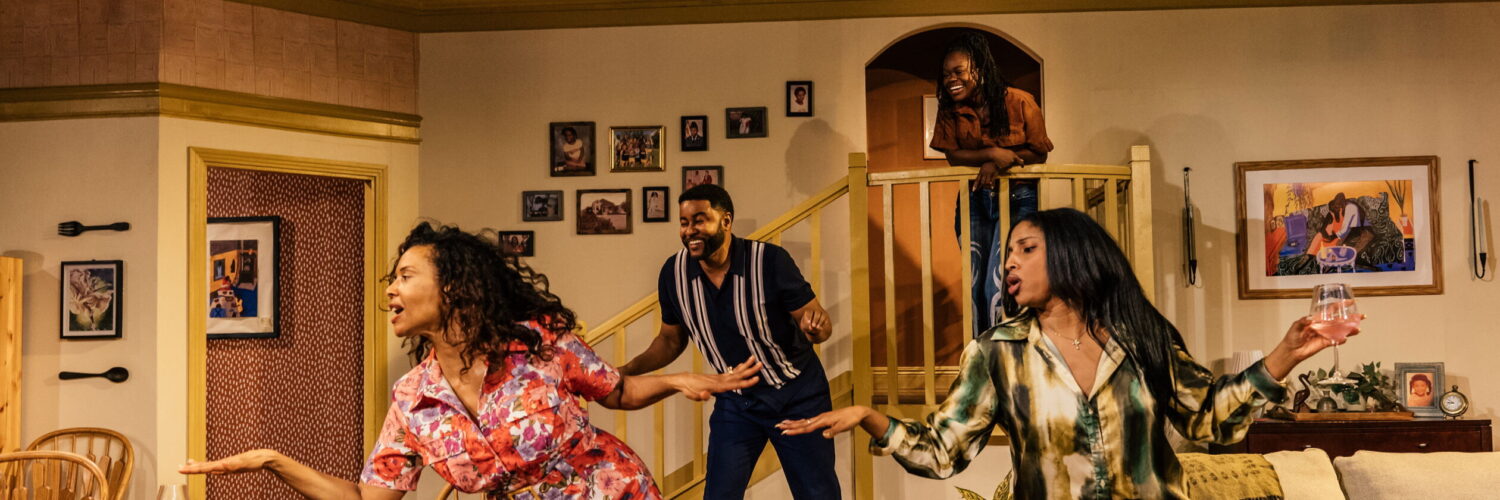
Then the three-act play commenced. The characters were loud, broad and hilarious.
Plot:
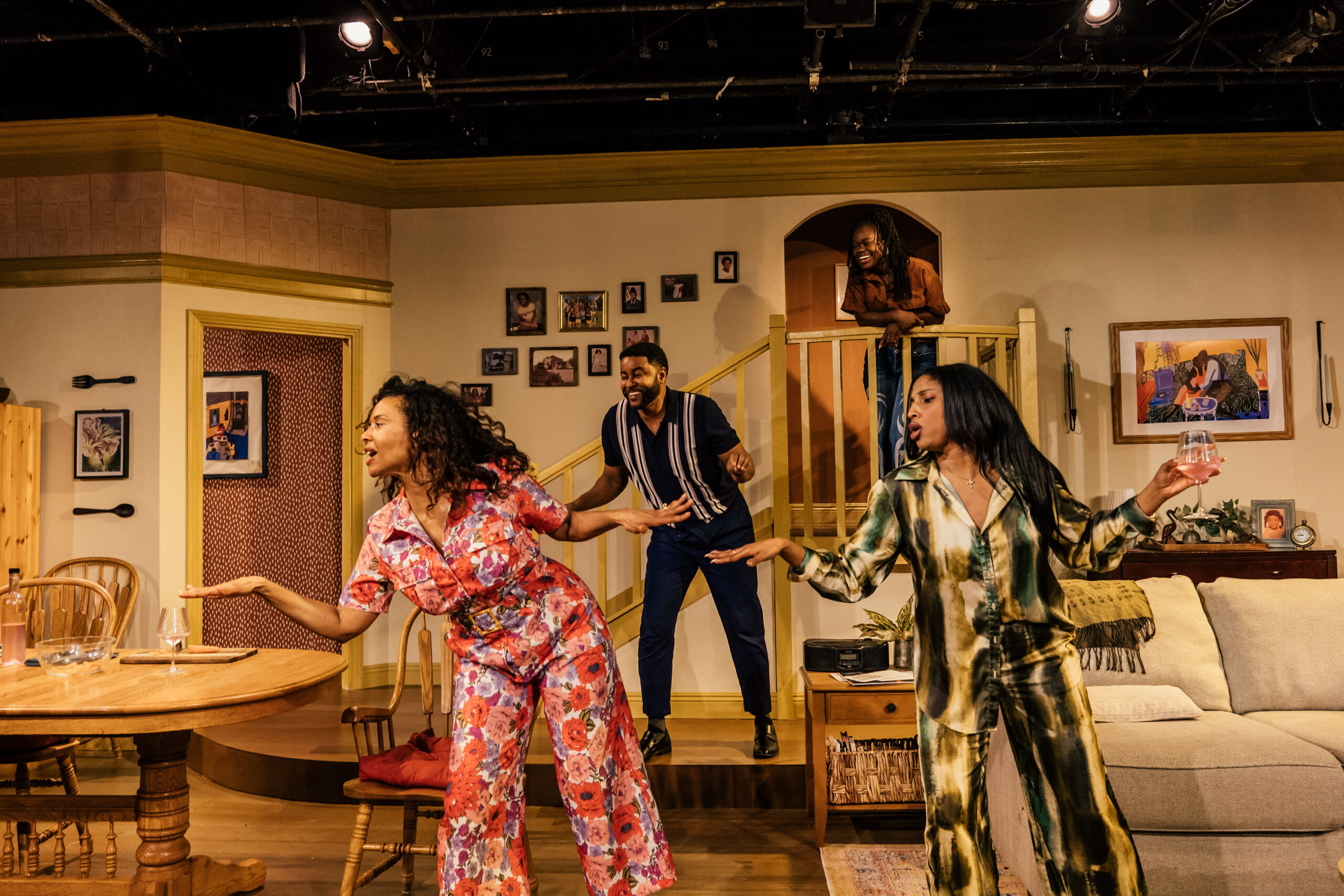
At the Frasier household preparations for Grandma’s birthday party are underway. Beverly is holding on to her sanity by a thread to make sure this party is perfect, but her sister can’t be bothered to help, her husband doesn’t seem to listen, her brother is MIA, her daughter is a distracted teenager, and maybe nothing is what it seems in the first place…
We meet Beverly, an anxious mother (played brilliantly by Marie-Françoise Théodore) who is stressing about the important party. She’s feeling pressure to make sure Grandma’s celebration goes well, but she’s clearly way behind schedule with the food preparations. She’s concerned that her well-meaning but distracted husband Dayton (played with humor and charm by Marco Martínez) hasn’t bought some of the necessary ingredients. But Dayton seems oblivious to the emotional chaos unfolding. He keeps sitting down on the couch and grabbing the TV remote as if he’s planning to watch a sports game. Somehow, he never seems to get the opportunity before Beverly insists he fetch some more essentials – tasks which he hopelessly fails thanks to his weaponized incompetence.
The first person to arrive at the upper-middle class house is Beverly’s glam and self-absorbed younger sister Jasmine (a pitch-perfect and hilariously over-the-top performance from Jasmine Ashanti). Jasmine is less invested in helping out with the party preparations, and more interested in getting her drink on. The honored party guest – Grandma – is upstairs (and doesn’t appear until her grand entrance in Act Three). Daughter Keisha (iesha m. daniels) returns home from sports practice, but the thoughtful teen has too much going on in her world to help out much.
We see Beverly painstakingly cutting up the carrots into tiny pieces. Oddly, she doesn’t seem to be making any progress at all and her anxiety is contagious (at least, for this audience member). Another sign that something’s a bit off—doesn’t this woman know how to cook? At all??
The 90-minute (no intermission) serio-comedy was broken into three half-hour acts. But this three-act structure gradually and unexpectedly dismantles the audience’s expectations. How? Read on!
At first, the play presents itself as a familiar domestic sit-com, grounded in the rhythms of everyday family life. But in the second act, the perspective shifts dramatically. After a quick stage reset, the action of Act One begins over, with the same performers miming their way through the whole performance we just watched. All the while four omni-present voices, white characters Jimbo, Mack, Bets, and Suze, comment and debate issues of race. I have to say I audibly uttered a dismayed “No!” the minute I realized what was happening. Act Two is kind of boring, to be frank. It’s more like listening to a podcast than watching live theater, despite the pantomime happening onstage – mainly because we are now watching it unfold for the second time.
As the white characters comment on the family dynamics, their casual speculation about the characters’ lives quickly becomes unsettling, revealing layers of assumption, stereotype, and projection. What initially feels playful soon becomes increasingly disturbing as their commentary exposes the ways people (such as us, the audience) interpret and frame the lives of others.
By the third act, the theatrical structure itself begins to fracture. The barrier between characters, observers, and the audience collapses, transforming the play into a direct confrontation about who is watching whom and why. Drury turns the theatrical lens back onto the audience, asking us to examine their own role in the act of observation. It’s intensely discomforting and deliberately challenging.
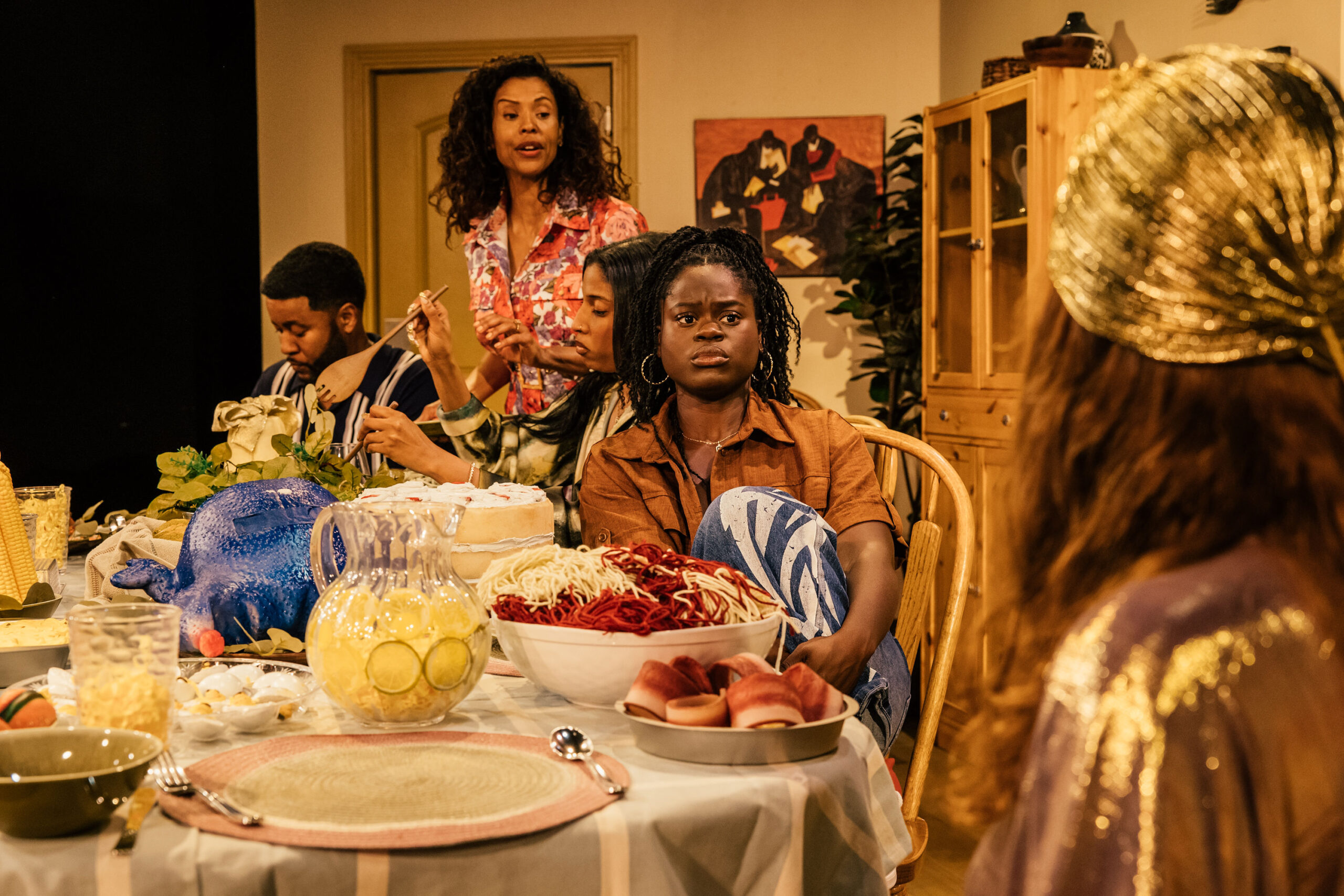
For Act Three the actions of the Black characters resume the story / party. Beverly’s mother enters the scene and Keisha is horrified at the bizarre appearance of her grandmother. As soon as those omni-present white actors enter the play as Black characters, Keisha becomes more and more distraught as these white people try to fit into Black misfortune. Then there’s a slapstick scenario featuring some ingeniously fake food.
The play ends with Keisha breaking the fourth wall and addressing the audience about how Black people need to tell their own stories and how white people need to participate as listeners, encouraging the white members of the audience to switch places with the Black actors onstage. Yes! All the white audience members were invited to come onto the stage and – shockingly – most of them did! Awkward!!
Turns out, the joke’s on us.
Fairview brilliantly taps into a dynamic long familiar to television audiences: the frazzled woman trying to hold a household together while the men, teens and children around her flounder or remain oblivious. This tension is immediately relatable, echoing classic African American sitcoms where women’s labor and emotional labor take center stage, reminiscent of Clair Huxtable (Phylicia Rashad iconically portrayed the poised, intelligent, and working-mother on The Cosby Show), Florida Evans (famously portrayed by Esther Rolle on the 1970s sitcom Good Times), or Mary Jenkins (Marla Gibbs played the lead role in the mid-eighties American sitcom 227).
Where Fairview diverges is in its intensity and insight. Unlike those sitcoms’ broad comedy, Drury’s Pulitzer Prize–winning text sharpens these family dynamics to a searing edge, exposing the assumptions, stereotypes, and social scripts that shape both the family’s interactions and the audience’s gaze. The play’s first act feels familiar and sitcom-like in its zany depiction of domestic chaos, but the second and third acts fracture that comfort, introducing outside observers and challenging the audience to examine the ways they watch and interpret Black lives on stage. We feel a bit shamefaced for enjoying the broad humor in the first act. Upon reflection, the intentionally broad tone of Act One reminded me of the scene in Cabin in the Sky, the all-Black MGM musical directed by Vincente Minnelli. Two black actors converse normally backstage while putting on blackface only to play exaggerated goofy caricatures in a vaudeville sketch where their jalopy falls to pieces.
In this fine production directed by Oz Scott, the cast navigates the comedy, frustration, and underlying social commentary with precision. iesha m. daniels’ teenage observant energy, Marco Martínez’s distracted charm, and the ensemble of the outside observers – Tyler Gaylord, Michael Guarasci, Gala Nikolić, and Daisy Tichenor – bring Drury’s layered structure to life. By the final act, what began as a seemingly ordinary family comedy becomes an unflinching confrontation with race, identity, and perception.
I figured out what they were going for pretty early on. Just because it was an uncomfortable experience (for me) doesn’t mean it was a bad play. But it was super annoying and boring in the middle, and the end was quite confusing and failed to deliver a decent payoff.
Nevertheless, I urge you to see this play and decide for yourself.
Fairview by Jackie Sibblies Drury
The Los Angeles Premiere and Winner of the 2019 Pulitzer Prize for Drama
Directed by Oz Scott
Rogue Machine at the Matrix Theatre
7657 Melrose Ave, Los Angeles, CA 90046
(Street parking available)
Performances:
8pm Fridays, Saturdays, Mondays; 2pm Sundays through April 19, 2026
(no performances on March 16, April 13)
The play contains adult language, loud noises, and strobe lights.
Or call for more information – 855-585-5185
Tickets: $45.00
Seniors: $35.00 Students with ID: $25.00
Shows4Less on Fridays March 20 ($15+), March 27, 2026